Showing posts with label Gardening tools. Show all posts

Sunday, May 1, 2022

Two geezers and a shed--part 2

After 10 years, the shed needed some work.
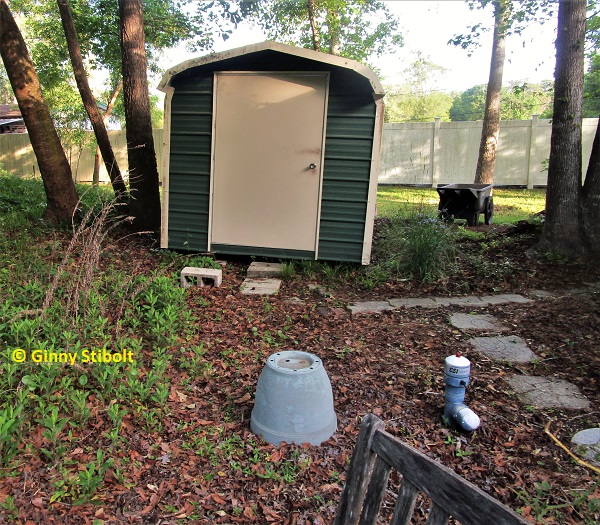
Our shed had a noticeable tilt after ten years.
In the foreground, the pot sits on the top of the septic holding
tank and the septic drainage field mound is to the left.
In 2012, my husband and I moved the shed that came with our house closer to the garage so that it would be more useful. I documented how we moved the it using pvc pipes as rollers and pulled it slowly across the yard with our van to its new location. That was quite a project and my "Two geezers and a shed" article is still one of the most visited posts on this blog.

These days the shed is heavily used for tools, pots, and other gardening supplies. But the oak tree to its left had grown and had tilted the whole shed a few degrees, and on the right, there were large roots also touching the bottom of the shed.

At first, we thought we would have to move it a foot or two to the right, but after clearing out the leaves and sticks from under the shed, we decided to just raise it in place. We know that this is not a permanent solution because the trees' roots will continue to grow. 

Saturday, September 1, 2018

Moving to battery-powered tools

Reduce the use of power tools


One action we can take to have more sustainable and climate-wise landscapes is to modify the arrangement of landscape elements and the interface between those elements to minimize the need for power tools. This can be accomplished in many ways. If we use plants that are appropriate for the size of the space in the landscape, they won't need to be trimmed back over and over. In addition, if there is still some lawn, the edges of the mowed spaces should consist of gentle curves and no vertical elements right next to them so that the mower can make one sweep around the edge and not have to come back with an edger or string trimmer to finish the job. If there are raised beds or buildings that are next to mowed areas, install a narrow mulched path or a row of pavers set into the ground at about an inch above the level of the lawn between the lawn and the vertical structure so the wheels of the mower can run outside of the lawn edge on the mulch or the pavers.

That being said, in many landscapes power tools are required for adequate maintenance. The sustainable and climate-wise action is to replace polluting, gas-powered tools with those powered by batteries.

When you switch to battery-powered tools, purchase those that are compatible so the batteries can used in all of the tools. It takes about 30 minutes to charge a battery with this particular type of fast charger. The time of use for a battery is more than an hour of actual run-time, depending upon the tool, the power setting for any given tool, and the job at hand.

Monday, March 5, 2018

Build a pine-straw baler

A pine-straw baler made from scrap lumber 
Our neighbor Tim had this apparatus in his front yard. We wondered what the heck it was. Tim has a lot of big pine trees on his property, which, of course, generate a lot of pine needles. So he'd built this pine-straw baling machine out of scrap lumber he had on hand.

Monday, August 6, 2012

Two Geezers and a Shed!


The garden shed in its original place was too far from the house to be useful.
When we purchased our house back in 2004, it came with an 8 x 10 foot garden shed about 180 feet behind the house, which is about half way down to the lake. In this position, it was too far from the house and garage to store garden tools and it was too far from the lake to be used as storage for boating equipment. We’ve used it to store tomato cages and some little-used tools like a posthole digger. We had not removed the stuff left over from the previous owner—gallons of partially used paint, a pickup truck toolbox, PVC pipe leftover from various projects, a non-working pump, and other junk.