
Seed-producing plants use sexual reproduction to produce their seeds and are divided into two main groups:
- Angiosperms, the true flowering plants with enclosed ovaries where the seeds are housed in a fruit.
- Gymnosperms, with naked seeds usually housed in cones or cone-like structures.
 |
| Seed plant reproductive configurations, but many people combine homoecious (self-fertile or perfect flowers) with monoecious since each plant has both male & female flowers or flower parts. |
There are 3 arrangements or configurations of these sexual organs:
1) Dioecious where the male and female structures are housed on separate plants. The main advantage to this arrangement is that cross pollination is forced, so there is more genetic diversity, which allows the plants with the best characteristics to adapt to a changing environment. The disadvantages are that only half of the plants produce seeds and the spread into to new territories is slowed because both male & female plants must be within breeding range.
2) Monoecious where male and female structures are separate, but on the same plant. The advantage is that the male and female structures are close, but pollination still needs to take place and more cross-pollination may occur. Examples include the squash family (Cucurbitaceae) with separate male & female flowers and some grasses like corn (Zea mays) with their male flowers at the top of the plant and the female flowers tucked into leaf notches that become the ears.
3) Homoecious, hermaphroditic or self-fertile where male and female parts are housed in the same structure. For Angiosperms, this would be a "perfect flower." The advantage is that pollination is much more likely, but one disadvantage is that self-fertilization is likely, which causes less genetic diversity. Some hermaphroditic plants have adapted so they cannot fertilize themselves. The vast majority of angiosperm flowers are perfect.
Dioecious derives from Greek meaning two houses, and as you can probably guess, monoecious means one house. Homoecious is self or the same house.
About 6% of angiosperms are entirely dioecious and about 7% of angiosperm genera contain some dioecious species. Woody plants such as hollies & maples are more likely to be dioecious than herbaceous plants.About 65% of gymnosperm species are dioecious, including all cycads (Coontie), most yews, and junipers (Red cedar), but almost all other conifers, including pines, are monoecious with separate male and female structures on the same plant. This is strongly correlated with the mode of seed dispersal; monoecious species are mostly wind dispersed and dioecious species animal-dispersed.
~ ~ ~
 |
| The European grape (Vitis vinifera) is homoecious or self-fertile: each flower has male & female parts. These are "perfect flowers." |
Most grapes are dioecious
There are about 80 grape species around the world, but almost all of the grape vineyards grow various cultivars of the self-fertile European grape (Vitis vinifera). Even the Latin name says it's the wine grape, because people were producing wines from this grape long before Carl Linnaeus assigned the name. Of course, there is a good reason for this, since the European grape is self-fertile, all the plants in the vineyards produce fruit. If you grew dioecious grapes, you'd need to include some male plants for pollination, but they would not bear fruit.
Muscadine grape (Vitis rotundifolia)
The muscadine grape is native to all of Florida and from Delaware to eastern Texas. This is grown as a sustainable crop in Florida and has been bred so that this normally dioecious plant (with separate male and female plants) is self-fertile or monoecious.
Fortunately, a few muscadine grape vines that had self-fertile flowers were discovered, and through breeding, this trait was introduced into new cultivars with good berry quality. This meant that self-fertile vines could be used to pollinate the female cultivars, and berries could be harvested from the entire vineyard. Read my grapes article.
~ ~ ~
 |
| Date palms have been under cultivation for 1000s of years. Growers learned to manage their orchards by cloning female plants and manually pollinating them. (This is a slide from my palm presentation.) |
Date palms
The date palm (Phoenix dactylifera) is the only major crop plant that's dioecious. Dates are naturally wind pollinated, but the wind doesn’t carry the pollen very far, so in both ancient oasis horticulture and in the modern commercial orchards they have been pollinated manually. Natural pollination occurs with about an equal number of male and female plants. But, with human assistance, one male tree can pollinate up to 100 females. Since the males are of value only as pollinators, this allows the growers to use their resources (both land and water) for more fruit-producing female plants.
There are a few ways to fertilize the female trees. The traditional method is to cut off all the male flower heads and to tie pieces of those male flower heads to the female flower heads. Now, date farmers are more likely extract all the pollen and then use the pollen dust sprayed from a cherry picker for more efficient pollination. The date palm flowers do not attract the usual array of insect, bird, or bat pollinators, but this palm has offered enough incentives for humans, that WE have become the de facto pollinators for the last few thousand years.
Growers learned early that if you want to grow new trees that you don’t plant the seeds because half of them will be males, but you won’t know for up to 10 years until it produces its first flowers, so that’s a lot of resources used just to determine its gender. Learn more about palms here.
~ ~ ~
 |
| A female persimmon with green fruit growing wild in my North Florida neighborhood. |
Persimmons are dioecious
Diospyros is a genus in the ebony family with more than 700 species, some are known as ebony trees, while others are known persimmon trees. The name is derived from Greek meaning food for the gods. There are only 2 species native to North America.
1. The American persimmon (Diospyros virginiana) native from Connecticut to Texas including most of Florida.
2. Texas persimmon (D. texana) native to Texas into Mexico.
The native American species bear much smaller fruits with larger seeds compared to the commercial Asian persimmons (D. kaki). Many of the cultivars used for fruit have been bred so the female plants produce fruit without being pollinated and the resulting fruits are seedless. Even so, persimmons are a minor crop because the fruit has no shelf life and unripe native persimmons are astringent and contain high levels of tannins, causing an intensely dry, bitter feeling in the mouth. Do not consume until the fruit softens significantly or experiences a frost.
~ ~ ~
 |
| Hollies (Ilex spp.) are dioecious. This is a female tree in our North Florida neighborhood. |
Most hollies are dioecious
Hollies (Ilex spp.) are famous for their berries, which have been particularly appreciated during the winter and are often associated with the winter holidays. Their winter fruit is particularly important for birds, especially migrating birds, but they are only borne on female trees.We pass the dahoon holly (I. cassine) in my photo here on our morning walks. In early fall it's heavy with fruit, which are actually drupes and not berries, but by the end of the winter, all the berries have been eaten.
Yaupon holly (I. vomitoria), native to SE states, & Yerba mate (I. paraguariensis), native to South America, both produce caffeine and are used to make tea. Read "Why do plants produce caffeine?" for more information on this.
~ ~ ~
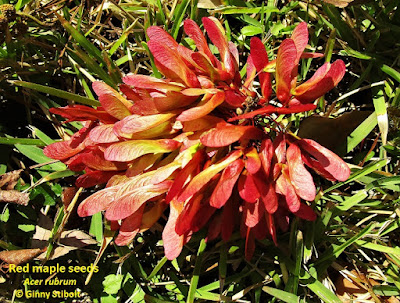 |
| A large clump of seeds from a female maple tree. |
Maple trees are complicated
Maples are mostly dioecious, which means that a tree will bear either male or female flowers, but unlike many other dioecious plants, the maples can change the sex of the flowers they bear. Maples can also bear both male and female flowers, especially if they are isolated from other maples. Also, the flowers are usually unisexual, with male and female flowers appearing in separate structures, but sometimes they are also bisexual. This sexual flexibility has a label: maples are polygamodioecious.
Learn more about Florida's maples here.
I hope that you enjoyed this deep dive into plant reproduction strategies.
Green Gardening Matters
Ginny Stibolt

No comments:
Post a Comment