Showing posts with label Botany. Show all posts

Saturday, August 1, 2026

Epiphytes: Air Plants & More

Ball moss is a common epiphyte & is typical
of what most people imagine when they
think "air plant." It attaches itself to a tree
& spends its life there.
 

Epiphyte derives from Greek epi- 'upon' and phyton 'plant'. An epiphyte is a non-parasitic, organism that grows on a plant and that derives moisture & nutrition from its surrounding ecosystem. Most people associate this with the terrestrial epiphytes or "air plants" that make their living without touching the ground, but wait, there's more...

Terrestrial epiphytes

Terrestrial epiphytes are plentiful where there is frequent rain or fog such as rain forests (both tropical and temperate) and also areas like Florida, especially near wetlands, but some epiphytes are also found in drier areas. They could be vascular flowering plants such as orchids, cacti, or bromeliads including ball moss & Spanish moss. They include vascular spore-producing plants such as ferns. Almost 10% of vascular plants are epiphytic.  Non-vascular, spore-producing plants such as mosses and club mosses are frequently epiphytes. 

Since epiphytic life can be precarious, many of these plants have fine hairs or waxy surfaces to trap or keep water. Some collect water in-between their leaves, but others have adapted to water shortages by using the CAM or C4 method of photosynthesis that can take place even when all their stomata (leaf pores) are closed to conserve water.

Lichens, which are not plants, but 3-way symbiotic organisms (fungi, algae, & bacteria), are also epiphytes when attached to plants. 

Strangler figs (Ficus spp.) are a special case: they are hemi-epiphytes when they begin life as a epiphyte high in the canopy, but when their aerial roots reach the ground, they are no longer epiphytes. It's a clever strategy, especially in rain forests where there is low light on the ground and the canopy is crowded. It's in the light when its young and it often takes over its host's spot in the canopy after strangling it by wrapping its roots around it.
(See below for more on terrestrial epiphytes.)

These barnacles, sessile animals (crustaceans),
attached to a kelp stipe (stem above the holdfast),
are marine epiphytes. 

Marine epiphytes

In the marine environment, plants, such as non-vascular seaweeds and vascular, flowering seagrasses, provide surfaces where sessile organisms can settle. Marine epiphytes include algae (micro & macro), bacteria, sponges, bryozoans, ascidians, protozoa, hydroids, crustaceans, & mollusks. They make their living from the nutrients and oxygen from the surrounding water, not from the plants. Sometimes, when there are too many epiphytes, the host plant may suffer from lack of light or lack of its own gas exchange.

Sunday, February 1, 2026

Alders Fix Nitrogen

Smooth alder or hazel alder (Alnus serrulata)
Photos by Georgia Native Plant Society

Hazel alder or smooth alder (Alnus serrulata) is blooming now with its showy yellow catkins. The woody female flower heads look like little pine cones. It's a tall multi-stemmed shrub to small tree in the birch family (Betulaceae).

This alder is native to freshwater and brackish water wetlands from Texas to Maine and into North Florida. It plays an important role in these wetlands because it fixes nitrogen in its root nodules using Frankia, a genus of anaerobic, filamentous bacteria in the Actinomycetes order. 

When soil is wet all or most of the time it is anaerobic (without air) and in these conditions, the normal soil microbes cannot survive and most plants cannot obtain enough nutrients from this soil. The alders' symbiotic relationship with this weird bacteria provides the nutrients they need to survive and they do so without much competition from other plants.

Thursday, January 1, 2026

Florida Betony

Florida betony develops ridged tubers that
look sorta like a rattlesnake tail and are edible.

Florida betony (Stachys floridana) is an aggressive perennial wildflower. Most botanists think that it was originally endemic to Florida, but now has spread to most of the Southeastern states from Virginia to Texas. It's a member of the mint family (Lamiaceae) and has the typical square stems and opposite leaves along the stems. The beautiful bilateral flowers range from whitish to purple arranged on a spike. It does best in damp soils.

The tubers are edible

It's also known rattlesnake weed because of its rattle-like tuber. Florida betony tubers are edible when harvested in the spring when they are firm and white, but only if the area has not been poisoned with lawn-care chemicals. They have the crispness of a water chestnut with a taste reminiscent of a very mild radish. Most people don't eat them later in the season when they turn tan or yellow and are not as crisp.

Saturday, November 1, 2025

This year's roselle crop was amazing!

The roselle was almost as tall as the house.

This year's roselle (Sabdariffa gossypiifolia formerly Hibiscus sabdariffa) crop was amazing even though we were out-of-town for almost 2 months starting at the end of March and again for a month in midsummer. I planned for survival of the roselle shrubs during these trips in a couple of ways. 

- I'd planted them on the back (house-side) of a 10'-long swale and surrounded the area with several wire tomato cages to keep them upright and also to protect them from the deer. 
- The bottom of the swale had been enriched with several loads of kitchen scraps when the roselle shrubs still were small. (Read this article for details on composting in place.) 
- I'd planted tomatoes mostly to one side of the roselle bed, but then strung the sprawling tomato plants onto the front tomato cages. This was also to keep the deer away, because they do not favor tomatoes.
- Before we left on our trip in March, I placed the end of the rain barrel hose into the swale and left the rain barrel on a very slow drip. This way all the water from that downspout was used to irrigate the roselle. 
- Before we left on the second trip, I propped up the plants and tied them together to two 12' poles and to the house. 

Friday, August 1, 2025

Coral honeysuckle creates habitat

The coral honeysuckle flowers are attractive
to us and to pollinaors, especially hummingbirds.

Coral honeysuckle, an easy-to-grow native for Florida and beyond.

Coral honeysuckle or scarlet honeysuckle (Lonicera sempervirens) is native to most of eastern North America from eastern Texas to Massachusetts, including all but the southernmost counties in Florida. It's in the honeysuckle family Caprifoliaceae.

It has opposite leaves along each stem, but the leaves that subtend the inflorescence (flower head) are joined together. This is known as perfoliate leaves. 

The long tubular flowers, which are borne only on new wood, are especially favored by hummingbirds, but butterflies, bees, and moths also visit the flowers. After pollination, fruits, which are true berries, develop and are an important food source for many birds, especially the Northern Cardinals (Cardinalis cardinalis). They also are the birds we seen most often nesting in the honeysuckle. 

Tuesday, July 1, 2025

The importance of Oaks

An oak branch in the white oak group

Oaks

Most oaks (Quercus spp.) are hardwood trees and have been used by people over the ages for building structures and boats. The oak fruit is a true nut with a hard shell and a cap, called the cupule, which protects the kernel. The kernel, which consists of two fatty seed leaves, called cotyledons, which surround a small embryo. This is an important food for wildlife and for early humans once they learned how to remove the bitter tannins.

Oaks are divided into two major groups. The white oaks are those with rounded lobes on their leaves and the acorns mature within one season and are less bitter. The red oaks generally have pointed lobes or sharp lobes on their leaves and their acorns stay on the trees for two seasons, so their acorns have more tannins and are therefore more bitter.

Thursday, May 1, 2025

Sweetbay magnolia, a lovely tree with highly scented flowers

The beautiful sweetbay magnolia flower
is pollinated by beetles.

The sweetbay magnolia (Magnolia virginiana) is lovely, mostly evergreen medium-sized tree with leaves that are dark green on top with silver undersides. It has beautiful, fragrant flowers and bright red fruits. It is tolerant of flooding, even with brackish water. It grows best in acid soil in full sun or partial shade.

It provides excellent habitat for wildlife. While it's pollinated by beetles, a wide variety of birds and other wildlife consume the fruits, plus it's the larval food source for several butterflies including the Spicebush Swallowtail (Papilio troilus) and the Eastern Tiger Swallowtail (Papilo glaucus). It should be planted much more often.

Saturday, February 1, 2025

Morning glories: So much more than just pretty flowers

The iconic tall or common morning glory
(I. purpurea) is a garden favorite around the world.

Iconic garden morning glories

When most people think of morning glories, it's the tall or common morning glory (Ipomoea purpurea) that they envision. It's a vine native to Mexico, Central and South America, but its beautiful blossoms and vigorous growth even in poor conditions have made it a garden favorite around the world. There are hundreds of named cultivars.

Each delicate flower lasts only one day and they look best in the morning when they first open; hence the name "morning glory."

Wednesday, January 1, 2025

How palms work

A cabbage palm tree (Sabal palmetto) silhouetted
by a sunrise on the St. Johns River.

Palms decorate tropical and subtropical regions of the World

Palms are monocots. Angiosperms or true flowering plants are divided into two major groups—monocots and dicots, which have various differences, but are named for the number of seed leaves or cotyledons they have. 

Monocots also include grasses, orchids, gingers, bananas, and bamboo. Also, most of the bulbs including onions, garlic, lilies, tulips, and more, but probably most important characteristic for our discussion on palms, there is no real wood with annual rings. The vascular tissue (the phloem and xylem) in monocots is arranged in bundles throughout the stem. In a dicot, they occur in the cambium layer just under or inside the bark around the plant stem. It is the new set of xylem and phloem cells that are produced each year which form the annual rings that produce the wood in true trees.

Sunday, October 6, 2024

Two weeds: one native and one nonnative

While the sharp, hard spikes
 on the seeds hurt our feet and
embed themselves in the
lawnmower tires, this is their
method of dispersal. 

Sand spurs

Six species of sand spurs or sandburs (Cenchrus spp.) are native to Florida. They are true grasses in the grass family, Poaceae.  While native plants are highly recommended for sustainable, climate-wise landscapes, these are not desirable because of the hard and very sharp prickles that cover their seeds. 

They have volunteered in our yard only out by the road where the other plants in our freedom lawn are a bit more sparse and where the neighborhood dog walkers visit on a regular basis. So even though I have cleared out this population of annual plants before, new ones can get a start out there when dogs bring more seeds from elsewhere.

Sunday, September 1, 2024

Grapes (Vitis spp.)

A muscadine grape (Vitis rotundifolia 'Alachua')
Credit: Ali Sarkhosh, UF/IFAS

Florida's grapes

There are six species of grapes that are native to Florida, while some have small ranges, grapes are found in all parts of the state. 

- Summer grape (Vitis aestivalis)
- Florida grape (Vitis cinerea var. floridana)
- Catbird grape (Vitis palmata)
- Muscadine (Vitis rotundifolia)
- Calloose grape (Vitis shuttleworthii)
- Frost grape (Vitis vulpina)

The muscadine grape is native to all of Florida and from Delaware to eastern Texas. This is grown as a sustainable crop in Florida and has been bred so that this normally dioecious plant (with separate male and female plants) is self-fertile or monoecious.

Monday, April 1, 2024

White Wild Indigo

It planted itself in a location that's too close to
 the sidewalk, but I'll leave it there since they
don't transplant well.

White Wild Indigo: A beautiful perennial pollinator plant

White wild indigo (Baptisia alba) is a plant worth including in your pollinator garden. It is pollinated by large bees including bumblebees and carpenter bees. It's also a host plant for Wild indigo duskywing and Zarucco duskywing butterflies. The fruits are eaten by birds. While it's an important plant in the local ecosystem, it's toxic to humans and livestock.

It is best propagated from scarified seed. Once established, plants should not be moved, since they have a long tap root. They take several years to reach maturity but are long-lived, and often grows 2-3 feet tall, frequently wider than it is tall. It produces showy white flowers March-May, but is dormant in winter. Use it as a small shrub or background plant in a border located in full sun to partial shade. 

It is a tri-foliate legume and can thrive in a variety of poor soils including acidic to neutral clay, loam, or sand. It naturally occurs in a sandhill environment, so established plants can tolerate some drought, but never flooding. 

Friday, March 1, 2024

Carrots: a most satisfying cool-weather crop

Carrots are native to Europe and parts of Asia and
Africa, but now have escaped around the world and
those wild carrots are known as Queen Anne's lace.

Carrots (Daucus carota) are in the carrot family Apiaceae. While this plant family includes quite a few well-known and economically important crop plants as anise, caraway, carrot, celery, chervil, coriander, cumin, dill, fennel, parsley, and parsnip, there are also a few highly poisonous species, such as poison hemlock, water hemlock, spotted cowbane, and fool's parsley. 

The defining characteristic of this family is the inflorescence, the flowers nearly always aggregated in terminal umbels, that may be simple or more commonly compound. The other name for this family is Umbelliferae. 

Monday, January 1, 2024

Ohio Spiderwort: a pollinator-friendly native wildflower

A small fly-like bee was pollinating this flower.

Bluejacket or Ohio spiderwort (Tradescantia ohiensis) is native to most of Eastern North America and to most of Florida. It attracts pollinators, especially bees. Each day, one or two flowers bloom in each flower head. They open early in the morning and then wilt in the afternoon. Each flower head contains twenty or more flowers and new flower heads are formed throughout the long season from early spring to late fall. There is a long blooming season.

There are three other species of spiderworts native to Florida: hairy spiderwort (T. hirsutiflora), longleaf spiderwort (T. roseolens), and zigzag spiderwort (T. subaspera). But the bluejacket has the largest native range and is the one that's most readily available from the native trade.

Spiderworts are monocots and are in the Commelina family (Commelinaceae), which includes 36 genera world wide, but only five occur in Florida. "Spiderwort" refers to the sap which dries into web-like threads when a stem is cut.

Thursday, November 2, 2023

Florida's goldenrods

Goldenrods do Not cause allergies

The insect-pollinated goldenrods (Solidago spp.) with their beautiful flowers have erroneously been blamed for fall allergy season when it's the wind-pollinated ragweed (Ambrosia spp.) with the unnoticeable green flowers that are filling the air with pollen when the goldenrods are blooming. The ragweeds do not need to put any energy into creating beautiful flowers or sweet nectar because the wind will blow anyway. As I understand it, some allergy doctors test people to see if they are allergic to goldenrod pollen even though that pollen is too heavy and sticky to float in the air and there is zero chance of its getting into anyone's nose. 

A swallowtail butterfly is pale in comparison to
the very yellow goldenrod.
Ragweed, the source of the air-borne pollen that gives people hay fever.

Sunday, October 1, 2023

Why talking about native plant landscapes is so important

Consumers are presented with this array of mostly
nonnative plants in full bloom to plant so their yards can
decorated with plants at peak bloom all the time.

Where are the native plants?

New homeowners and beginning gardeners find displays similar to this photo that I took at a big box store a few years ago. It's filled with mostly nonnative annuals in full bloom. Each tray is not too expensive, but after they fade in a couple of months, people are expected to come back to replace them with the next set. 

Examples in garden magazines and gardening TV shows with their instant landscapes imply that garden installations are events, and not ongoing projects that develop over the years.

Tuesday, August 1, 2023

Starry rosinweed is a star in Florida yards

Starry rosinweed is a star in your garden not only
for its beauty and long blooming cycle, but also because
of the wide variety of pollinators that it attracts.

Starry Rosinweed (Silphium asteriscus) is a member of the aster or daisy family, Asteraceae and is a wonderful choice for Florida's wildflower meadows and for pollinator gardens. It's a beautiful, tall, long-lived, drought tolerant, easy-to-care-for wildflower. (See below for more information on how it behaves in gardens and meadows.)

Botanically, the starry rosinweed is an outlier in the aster family. Yes, its flower head has the typical arrangement of disk florets in the center surrounded by showy ray florets that each have one outsized petal. 

In most aster family plants with this typical flower head arrangement such as sunflowers, only the tiny, cylindrical disk florets in the center produce fruits or seeds, while the petal-like ray florets around the outside of the center are sterile and produce no fruits. The starry rosinweed is exactly the opposite with its ray florets producing fruits and the disk florets being sterile.

Saturday, July 1, 2023

Why do plants produce caffeine?

I've covered this topic on my cruise ship presentations on coffee.
A bit of plant science for this post...

Caffeine is the most widely consumed psycho-active substance in the world!

Caffeine is not the work of Satan, nor the product of some mad scientists working in a chemistry lab; rather, it’s the result of millions of years of plant evolution. 

All plants build a variety of compounds including enzymes. Many of these molecules serve as a defense against enemies of the plants—large and small. 

Building caffeine is an expensive process (energy-wise) for the plant, so why do they do it? 

Monday, May 1, 2023

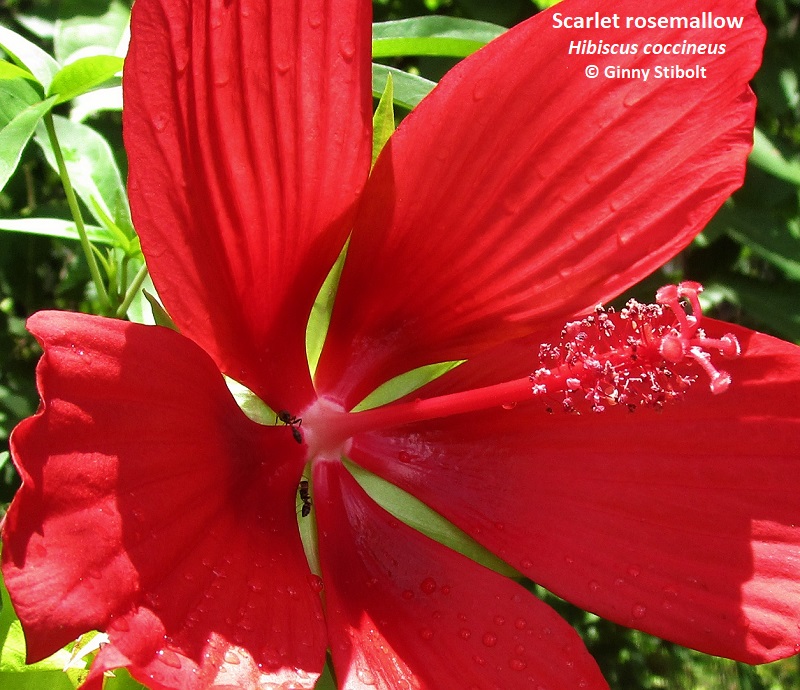
Hibiscus: Plants with the most beautiful flowers

A scarlet rosemallow (Muenchhusia coccineus):
 a Florida native

There are 432 Hibiscus species that are found worldwide, and with their beautiful flowers, many are grown in gardens and some are even used as crops. In general, the flowers are large and showy. (Updatre in June 2026: Some of Florida's native Hibiscus species are now Muenchhus, while some others are Sabdariffa.)

For example, see the scarlet rosemallow in the lead photo. Here there are five green sepals subtending five large red petals. The pistil, the female reproductive part of a plant, is attached to the center of the flower. The pistil is made up of a five-chambered ovary where seeds develop, the style that is a long tube between the ovary and five round stigmas where the pollen is absorbed. A stamen, the male reproductive structure, consists of the anther that holds the pollen, and a stalk called the filament. In hibiscus flowers, the filaments fuse into a tube that surrounds the style. Numerous anthers stick out from the filaments below the five stigmas at the top of the style. The prominent pistil with all those anthers is one reason the hibiscus flowers are so showy.

Saturday, April 1, 2023

Netted chain ferns

Netted chain fern: sterile fronds.

The netted chain fern (Woodwardia areolata) is native to eastern North America including most of Florida. It spreads via rhizomes and acts as a ground cover in partially shaded areas with some moisture. 

Leaves or fronds are dimorphic with the sterile leaves being flat and relatively broad for a fern, while the fertile fronds (those bearing the spores in structures called sori. (Sorus is the singular.)) are taller and have very little green leafy area. For this fern, sori are oblong and are arranged in neat lines, this is the characteristic that gives the chain ferns their name. In North Florida and in more northerly areas in its range, the green sterile fronds die back in the winter, while the fertile fronds persist through the winter.