Showing posts with label Trees. Show all posts

Thursday, May 1, 2025

Sweetbay magnolia, a lovely tree with highly scented flowers

The beautiful sweetbay magnolia flower
is pollinated by beetles.

The sweetbay magnolia (Magnolia virginiana) is lovely, mostly evergreen medium-sized tree with leaves that are dark green on top with silver undersides. It has beautiful, fragrant flowers and bright red fruits. It is tolerant of flooding, even with brackish water. It grows best in acid soil in full sun or partial shade.

It provides excellent habitat for wildlife. While it's pollinated by beetles, a wide variety of birds and other wildlife consume the fruits, plus it's the larval food source for several butterflies including the Spicebush Swallowtail (Papilio troilus) and the Eastern Tiger Swallowtail (Papilo glaucus). It should be planted much more often.

Saturday, June 1, 2024

Shrubs in the landscape

A newly renovated house in our neighborhood with its
newly-installed curb-appeal shrubs where there were none.

Shrubs as the default foundation plantings

Shrubs are easy for the builders to install and they give the landscape a "finished" and the expected look for a house.

Here's a house in our neighborhood that recently went on the market after extensive interior renovations according to its online listing. But what bothered me was that they removed two mature trees on the west side of the house, which cooled the area especially in the afternoon, removed the awnings on the windows, and then installed a row of useless, sprawling shrubs along the foundation. One of the trees may have been too close to the house, but the other one was fine. 

This was in 2022 when their azaleas were blooming. I was not
focused on the house, but the thickets.

I had taken a photo of this house in 2022 when their Japanese azaleas (Rhododendron japonicum), which are planted around some trees, were in bloom to include in my article, Habitat Gardening. The tree in the foreground is an old redcedar (Juniperus virginiana) next to the road, which is still there.

So the real problem with foundation shrubs is that they usually outgrow their spaces, some sooner than others. Sometimes it's just that they grow too tall, but other shrubs with aggressive spreading roots could also damage the building's foundation. 

Friday, September 1, 2023

Hurricane-scaping in Florida

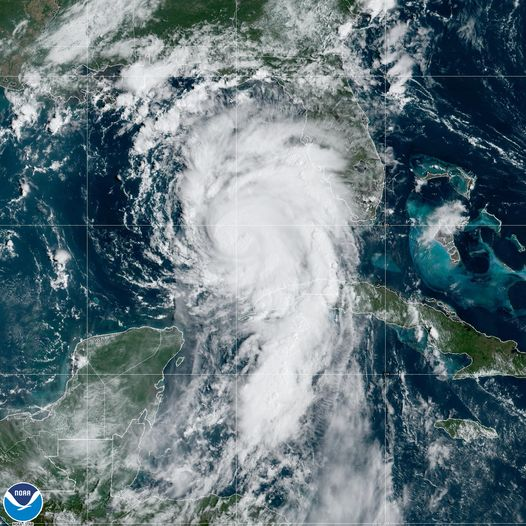
Hurricane Idalia 2023

Florida's hurricane season is from June 1 to November 30. These five months are also the wet season here when we receive up to 70% of our annual rainfall. Our hot wet summers make it difficult to grow some vegetables like sweet basiltomatoes and most members of the squash family, but growing crops is not the topic for this post.

As I'm writing this, Hurricane Idalia is pummeling the west coast of Florida. Florida is subjected to more hurricane activity than other states because the 1,350 mile-long coastline, which is surrounded by warm waters. When sea surface temperatures are above 82˚F, this warm water sustains and intensifies tropical storms that may strengthen into hurricanes. This year the Atlantic Ocean temperatures reached as high as 101˚F just off the east coast of Florida. So it's not surprising that we have been struck by a Category 4 hurricane.

Wednesday, February 1, 2023

The hand of the gardener in native landscapes

Plant more natives!

In 2013, a volunteer beautyberry shrub near the edge of the
lawn is surrounded by several water oaks.

Ecologists and environmental organizations have been urging people to plant more native plants, to build bird-friendly and pollinator-friendly habitat, and to do this by removing at least some of their lawn.

One prime example is Doug Tallamy's HomeGrown National Park where you can register your yard to be part of of this park by replacing at least half of the lawn with native plants.

This is great and I hope that millions of homeowners and other property managers take this step to build native habitat, but there are some important steps to take, especially in urban and suburban areas, to increase the acceptability of these native landscapes. Our yards and our community landscapes, even if they have a good portion of native plants are not wild spaces and will need some regular care. (Actually, I wrote a book on this topic. See below.)

Friday, April 22, 2022

The value of trees

 An appreciation of trees

Trees in our yards and in our communities add to the global
population, which is crucial for slowing down climate change.

Here are just some of the many ways that trees are important not only in our urban and suburban neighborhoods, but also for the whole planet:

- Trees actually cool the air through transpiration. A mature deciduous tree like an oak will transpire more than 400 liters of water on a hot summer's day. In the process of liquid water evaporating (going from liquid to gas) the air is cooled. At 68˚F each gram of water that evaporates, cools the air by 585 calories. Transpiration: Forests' most important service

- Trees sequester carbon, by absorbing carbon dioxide (CO2) a long-lasting greenhouse gas, through the process of photosynthesis where they remove carbon dioxide from the air to make sugars, which are then stored in the various plant tissues. A typical hardwood tree can absorb as much as 48 pounds of carbon per year. This means it will sequester approximately 1 ton of carbon by the time it reaches 40 years old. Carbon sequestration

- Trees produce oxygen through photosynthesis, but trees and all the other organisms in the forest absorb most of that oxygen to live. Also read Transpiration: Forests' most important service where I talk about three cycles in the forest: Carbon, Oxygen, and Water.

- Trees remove carbon monoxide (CO) and other air pollutants from the air. They are absorbed primarily through stomata (pores) on the leaves where they diffuse into intercellular spaces and may be absorbed by water films to form acids or react with inner-leaf surfaces. Trees can remove significant amounts of air pollution in cities, where it is often concentrated. More information on this from the EPA.

Tuesday, March 1, 2022

Red maples in Florida

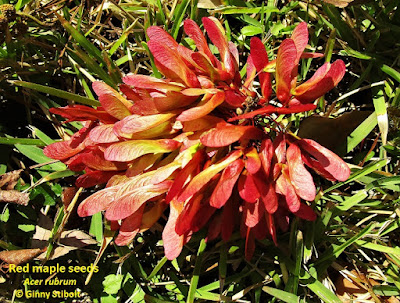
A large clump of maple seeds. It readily reseeds.

Red maples are versatile trees

The red maple (Acer rubrum) is native to most of Florida and its range also includes almost all of eastern North America including Canada. According to the U.S. Forest Service, it's one of the most abundant trees in this range, because it grows well in a wide variety of habitats and because it's easy to grow and has reliable fall color even in Florida, it is widely planted. It will grow in both wet and dry soil, but in the southern part of Florida it's mostly found in wet soils. While it prefers some acidity, it tolerates a variety of soil types.

Sunday, January 2, 2022

Wax myrtle: an under-used Florida native

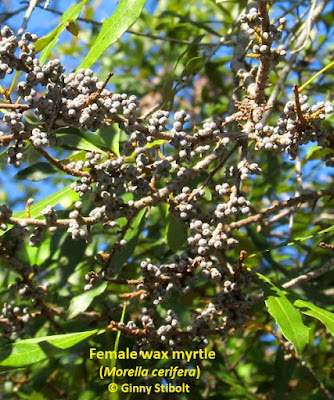
The female wax myrtles carry a heavy
load of berries that feed the winter birds.

Wax myrtle (Morella cerifera formerly Myrica cerifera) is an easy-to-grow evergreen shrub or small tree that typically grows to 10-15’ tall and 8-10’ wide, but sometimes it grows to 20’ tall or more. It's native to all of Florida, even The Keys, and naturally occurs in a variety of habitats including edges of wetlands, river margins, sand dunes, pine barrens, hillsides, and upland forests. Species epithet "cerifera" means wax-bearing.

This species is dioecious (male and female flowers borne in catkins on separate plants). Female plants are preferred in the landscape because they produce the fruit to feed the birds, particularly migrating birds during the winter. Of course, at least one male plant is needed in the neighborhood to facilitate pollination of the female flowers.

Tuesday, July 21, 2020

Winged elm: A beautiful Florida native

The winged elm is so named because of its corky
The winged elm (Ulmus alata) is a graceful medium-sized tree native from Virginia to Texas and to north Central Florida. It grows well in a variety of conditions and should be more widely planted. Gil Nelson describes it as a fast grower in his "Florida's Best Native Landscape Plants." I have to agree with this assessment given my experience with this tree.

In 2010, I was on my first flowered shirt book tour of Florida after the publication of "Sustainable Gardening for Florida." I spoke to a number of the Florida Native Plant Society chapters as part of that tour. At one of those chapters, I was given a winged elm tree that had been auctioned off. The member who won the auction decided that I should have it. Even though the tree was not in good shape, I gracefully accepted his gift and brought it home.

Friday, June 19, 2020

Birds of prey in our yard

Here's looking at you, kid!

Barred Owls

We're delighted that Barrel Owls (Strix varia) have occupied our non-poisoned yard for a number of years. We mostly hear them at twilight or dawn, but during mating season they are more active in the day.

They are opportunistic predators catching anything from small mammals to insects: including snakes, lizards, bats, birds, and even fish.

Their range is forested habitats across eastern North America and is now expanding into the Pacific northwest.

Sunday, January 26, 2020

Smart Gardening

Let's combat those horticultural myths with science 

This meme with a reminder to share
about male and female pepper fruits based on
 the number of lobes is total baloney!

The Internet has been a fantastic tool for sharing all of human knowledge. Social media, powered via the Internet, has made it easier to reconnect with long-lost friends and relatives and to share photos and memes with the world. It also serves as a market place, with online shopping.

But all this mostly unfiltered access to eye balls has made it ripe for spreading misleading information and blatant misinformation. Plus, this unfiltered marketplace allows for the selling of ineffective or bogus products with no chance for returns.

But, our topic is gardening and landscaping, so let's look at a few examples of bad information so widely shared that those myths have become accepted as fact.

Monday, November 11, 2019

Sequester this carbon! Don't throw it away.

Sequester this carbon! Don't throw it away.
Carbon sequestration is tremendously important because keeping the CO2 levels low in the atmosphere will help keep the earth cooler. It’s the most abundant greenhouse gas.

As I found in doing the research for the Soil section in "Climate-Wise Landscaping," soil sequesters four times more carbon globally than all the terrestrial plants added together, including rainforests. It varies by region and soil type with the peat bogs doing much of the heavy lifting.

Saturday, June 29, 2019

An update: red bay trees that died back from laurel wilt disease in 2008.

Three months before the red bay tree by the
pond turned brown, seemingly overnight,
two pileated woodpeckers gave warning
that bugs were infesting the tree.


Back in 2008, we were shocked when all the red bay trees (Persea borbonia) in our yard suddenly turned totally brown. One day they looked fine, the next day their leaves were all dead. After doing some research, I found that the cause for this was the laurel wilt disease, which was carried by the redbay ambrosia beetle, a tiny insect that entered this country in pallet wood from Asia in Savannah, Georgia in 2004. The beetle carries a fungus that blocks the xylem cells so the water stops flowing through the trees. This is why the symptoms are so sudden, because without the flow of water, the tree cannot function. The fungal disease is known as the laurel wilt disease. Other members of the Laurel family (Lauraeae) that are susceptible to this disease include both natives such as sassafras and spicebush, and non-natives such as avocado and camphortree. Here is a link to the article I wrote back then: Red bay trees are dying.

Thursday, February 14, 2019

Transpiration: Forests' most important service

Through transpiration trees extract huge amounts of water from the soil
and spew it into the atmosphere.

Three Major Cycles in Forests

For a better understanding of the overall value of trees, we'll look at the three major cycles in forests. There are many other processes that also take place, but these three will provide a big-picture look at what's going on in forests, which can then be downsized to fit into our local activities in our yards and in our communities.
1) The Water Cycle:  Water moves through trees, evaporates into the air, forms clouds, rains or snows, both locally and globally. Water from the precipitation is soaked up by trees.
2) The Carbon Cycle:  Carbon absorbed during photosynthesis and is released during respiration, fire & decomposition.
3) The Oxygen Cycle:  O2 is produced through photosynthesis and absorbed through respiration.