Showing posts with label Conservation. Show all posts

Sunday, February 1, 2026

Alders Fix Nitrogen

Smooth alder or hazel alder (Alnus serrulata)
Photos by Georgia Native Plant Society

Hazel alder or smooth alder (Alnus serrulata) is blooming now with its showy yellow catkins. The woody female flower heads look like little pine cones. It's a tall multi-stemmed shrub to small tree in the birch family (Betulaceae).

This alder is native to freshwater and brackish water wetlands from Texas to Maine and into North Florida. It plays an important role in these wetlands because it fixes nitrogen in its root nodules using Frankia, a genus of anaerobic, filamentous bacteria in the Actinomycetes order. 

When soil is wet all or most of the time it is anaerobic (without air) and in these conditions, the normal soil microbes cannot survive and most plants cannot obtain enough nutrients from this soil. The alders' symbiotic relationship with this weird bacteria provides the nutrients they need to survive and they do so without much competition from other plants.

Tuesday, July 1, 2025

The importance of Oaks

An oak branch in the white oak group

Oaks

Most oaks (Quercus spp.) are hardwood trees and have been used by people over the ages for building structures and boats. The oak fruit is a true nut with a hard shell and a cap, called the cupule, which protects the kernel. The kernel, which consists of two fatty seed leaves, called cotyledons, which surround a small embryo. This is an important food for wildlife and for early humans once they learned how to remove the bitter tannins.

Oaks are divided into two major groups. The white oaks are those with rounded lobes on their leaves and the acorns mature within one season and are less bitter. The red oaks generally have pointed lobes or sharp lobes on their leaves and their acorns stay on the trees for two seasons, so their acorns have more tannins and are therefore more bitter.

Monday, March 3, 2025

Miami's Underline Park

The Underline is an impressive
& well-used urban park located
under the Metro Rail in Miami.

Taking its inspiration from the High Line Park in New York City and The Lurie Garden in Chicago, The Friends of The Underline non-profit organization formed in 2013. The Underline is basically a multi-use path with parks, recreational spaces, playgrounds, plantings, and stormwater infrastructure. It's expected to extend to its full 10-mile distance by 2026.

These gardens feature untrimmed native plants that attract and feed insects and birds. This is different than traditional formal gardens where everything is tightly trimmed and exotic plants are chosen for their beauty and because they are not favored by the local insects. This style is left over from British and European upper class expectations where those who owned grand houses and estates favored those highly maintained gardens to show how wealthy they were.

Wednesday, January 1, 2025

How palms work

A cabbage palm tree (Sabal palmetto) silhouetted
by a sunrise on the St. Johns River.

Palms decorate tropical and subtropical regions of the World

Palms are monocots. Angiosperms or true flowering plants are divided into two major groups—monocots and dicots, which have various differences, but are named for the number of seed leaves or cotyledons they have. 

Monocots also include grasses, orchids, gingers, bananas, and bamboo. Also, most of the bulbs including onions, garlic, lilies, tulips, and more, but probably most important characteristic for our discussion on palms, there is no real wood with annual rings. The vascular tissue (the phloem and xylem) in monocots is arranged in bundles throughout the stem. In a dicot, they occur in the cambium layer just under or inside the bark around the plant stem. It is the new set of xylem and phloem cells that are produced each year which form the annual rings that produce the wood in true trees.

Sunday, December 1, 2024

It's Time to Think Globally, but Act Locally.

www.climatewiselandscaping.com 

Climate change is real!

We are seeing its effects on the weather with more frequent, stronger and slower-moving hurricanes, more severe droughts, more fires, and rising sea levels. But Sue Reed and I did not debate the reality of climate change or what has caused these rapid changes when we wrote our award-winning book, "Climate-Wise Landscaping: Practical Actions for a Sustainable Future." Instead we said, "Let's roll up our sleeves and get to work."

The same thing has happened in the writing of my 7th book with the working title "Living Shorelines for Florida: A Practical Guide for Building Resilience," which will be published in 2025. I and my three coauthors did not debate sea level rise or discuss what the causes might be, but plans for dealing with rising sea levels are included in our various actions and designs for more resilient shorelines.

So what actions can we take and will it make any difference?

While actions we take in our yards and in our communities may seem insignificant, there are many millions of homeowners and communities, and together, we are a powerful force. What follows are some ideas and links to resources for some of the most significant actions. 

Sunday, October 1, 2023

Why talking about native plant landscapes is so important

Consumers are presented with this array of mostly
nonnative plants in full bloom to plant so their yards can
decorated with plants at peak bloom all the time.

Where are the native plants?

New homeowners and beginning gardeners find displays similar to this photo that I took at a big box store a few years ago. It's filled with mostly nonnative annuals in full bloom. Each tray is not too expensive, but after they fade in a couple of months, people are expected to come back to replace them with the next set. 

Examples in garden magazines and gardening TV shows with their instant landscapes imply that garden installations are events, and not ongoing projects that develop over the years.

Monday, May 1, 2023

Hibiscus: Plants with the most beautiful flowers

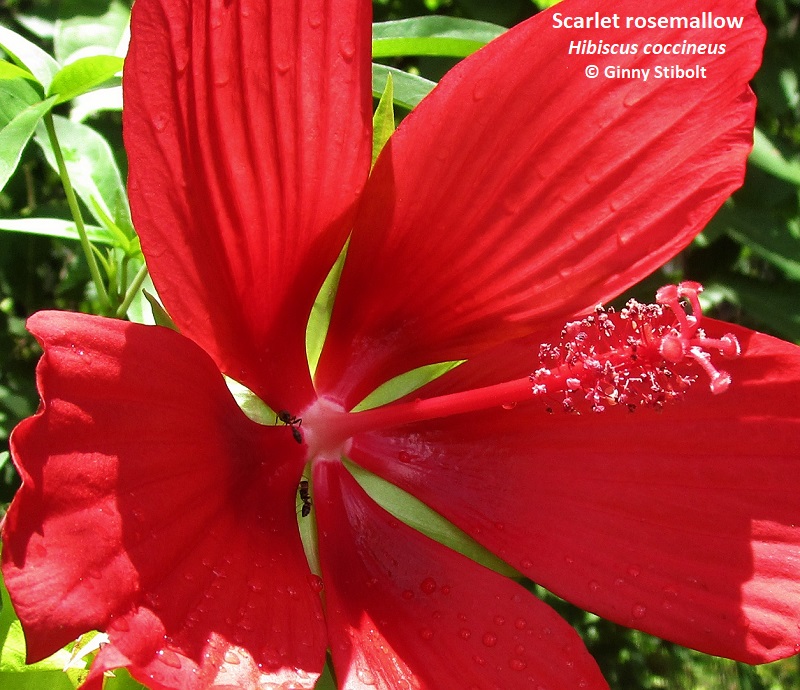
A scarlet rosemallow (Muenchhusia coccineus):
 a Florida native

There are 432 Hibiscus species that are found worldwide, and with their beautiful flowers, many are grown in gardens and some are even used as crops. In general, the flowers are large and showy. (Updatre in June 2026: Some of Florida's native Hibiscus species are now Muenchhus, while some others are Sabdariffa.)

For example, see the scarlet rosemallow in the lead photo. Here there are five green sepals subtending five large red petals. The pistil, the female reproductive part of a plant, is attached to the center of the flower. The pistil is made up of a five-chambered ovary where seeds develop, the style that is a long tube between the ovary and five round stigmas where the pollen is absorbed. A stamen, the male reproductive structure, consists of the anther that holds the pollen, and a stalk called the filament. In hibiscus flowers, the filaments fuse into a tube that surrounds the style. Numerous anthers stick out from the filaments below the five stigmas at the top of the style. The prominent pistil with all those anthers is one reason the hibiscus flowers are so showy.

Wednesday, February 1, 2023

The hand of the gardener in native landscapes

Plant more natives!

In 2013, a volunteer beautyberry shrub near the edge of the
lawn is surrounded by several water oaks.

Ecologists and environmental organizations have been urging people to plant more native plants, to build bird-friendly and pollinator-friendly habitat, and to do this by removing at least some of their lawn.

One prime example is Doug Tallamy's HomeGrown National Park where you can register your yard to be part of of this park by replacing at least half of the lawn with native plants.

This is great and I hope that millions of homeowners and other property managers take this step to build native habitat, but there are some important steps to take, especially in urban and suburban areas, to increase the acceptability of these native landscapes. Our yards and our community landscapes, even if they have a good portion of native plants are not wild spaces and will need some regular care. (Actually, I wrote a book on this topic. See below.)

Tuesday, October 4, 2022

Habitat gardening

In natural areas, the soil ecosystem supports the plants,
which support the insects, which in turn support
the birds and other wildlife.

Florida's default landscapes

Most yards in Florida consist of highly maintained monoculture lawns, a few stand-alone trees, and a fringe of foundation plants around the buildings. This is the opposite of habitat gardening because typical Florida lawn care includes regular landscape-wide applications of insecticides, herbicides, fungicides and other poisons. Then since these pesticides are not good for the turfgrass, synthetic fertilizer is applied to keep it green.

This treatment damages the soil ecosystem (shown in the poster here), which plays an important role in keeping the plants healthy, which then support the insects and the birds. In addition, much of the lawn chemicals have rinsed through the soil or have been carried away with erosion to pollute our waterways causing too much algae growth and toxic dead zones.

Friday, April 22, 2022

The value of trees

 An appreciation of trees

Trees in our yards and in our communities add to the global
population, which is crucial for slowing down climate change.

Here are just some of the many ways that trees are important not only in our urban and suburban neighborhoods, but also for the whole planet:

- Trees actually cool the air through transpiration. A mature deciduous tree like an oak will transpire more than 400 liters of water on a hot summer's day. In the process of liquid water evaporating (going from liquid to gas) the air is cooled. At 68˚F each gram of water that evaporates, cools the air by 585 calories. Transpiration: Forests' most important service

- Trees sequester carbon, by absorbing carbon dioxide (CO2) a long-lasting greenhouse gas, through the process of photosynthesis where they remove carbon dioxide from the air to make sugars, which are then stored in the various plant tissues. A typical hardwood tree can absorb as much as 48 pounds of carbon per year. This means it will sequester approximately 1 ton of carbon by the time it reaches 40 years old. Carbon sequestration

- Trees produce oxygen through photosynthesis, but trees and all the other organisms in the forest absorb most of that oxygen to live. Also read Transpiration: Forests' most important service where I talk about three cycles in the forest: Carbon, Oxygen, and Water.

- Trees remove carbon monoxide (CO) and other air pollutants from the air. They are absorbed primarily through stomata (pores) on the leaves where they diffuse into intercellular spaces and may be absorbed by water films to form acids or react with inner-leaf surfaces. Trees can remove significant amounts of air pollution in cities, where it is often concentrated. More information on this from the EPA.

Friday, October 1, 2021

Removing invasive plants costs Florida $45 million per year

Mimosa tree (Albizia julibrissin),
a Category I invasive in all of Florida.

Yet, many of these plants are still for sale

How did we get into this situation?

A few hundred years ago, once world travel was readily available, many plants and animals were transported from their native habitats where natural checks and balances evolved over millennia so that predator & food sources were in balance. (I will be talking about plants in this post, but invasive animal species are also a huge problem in Florida.) 

People moved thousands of plant species for a number of reasons:
- to bring food crops with them as they settled into new places.
- they collected beautiful plants from around the world to plant in gardens as a novelty or for prestige.
- Some plants were imported for their utility such as stopping erosion (such as kudzu (Pueraria montana)) or building fast-growing hedges (such as, Brazilian pepper (Schinus terebinthifolia)).
- Many non-native plants have been favored in the landscaping industry because most local insects and other critters do not feed on them, so they are easier to grow and sell, because they "look good."
and...
- Sometimes the plants were introduced to new regions by accident as hitchhikers with other plants or with other products that were being transported.

What is "invasive" and how is that status determined?

Monday, December 21, 2020

Celebrate Winter Solstice 2020

The winter solstice for the Northern Hemisphere occurs on
Monday, December 21, 2020 at 5:02 a.m. EST.

Sunrise over the St. John's River from
Spring Park in Green Cove Springs.

Winter Solstice is the astronomical moment when the Sun reaches the Tropic of Capricorn, which here in the  Northern Hemisphere produces our shortest day and longest night of the year and marks the official start of winter.

At the winter solstice, the sun appears at its southernmost position and at the lowest point in the sky, and its noontime elevation seems to stay the same for several days before and after this day. The sun’s gradual decrease in the sky reverses after the winter solstice and as the hours of daylight become longer, marking what many cultures believe to be a “rebirth” of the Sun.

The term “solstice” is derived from Latin: sol (sun) and sistere (to stand still) because, during the solstice, the sun appears to stand still.

Friday, June 19, 2020

Birds of prey in our yard

Here's looking at you, kid!

Barred Owls

We're delighted that Barrel Owls (Strix varia) have occupied our non-poisoned yard for a number of years. We mostly hear them at twilight or dawn, but during mating season they are more active in the day.

They are opportunistic predators catching anything from small mammals to insects: including snakes, lizards, bats, birds, and even fish.

Their range is forested habitats across eastern North America and is now expanding into the Pacific northwest.

Monday, November 11, 2019

Sequester this carbon! Don't throw it away.

Sequester this carbon! Don't throw it away.
Carbon sequestration is tremendously important because keeping the CO2 levels low in the atmosphere will help keep the earth cooler. It’s the most abundant greenhouse gas.

As I found in doing the research for the Soil section in "Climate-Wise Landscaping," soil sequesters four times more carbon globally than all the terrestrial plants added together, including rainforests. It varies by region and soil type with the peat bogs doing much of the heavy lifting.

Wednesday, January 9, 2019

Review: "Garden Revolution: How our landscapes can be a source of environmental change" By Larry Weaner and Thomas Christopher.

Cover Garden Revolution by Weaner & Christopher.
On my 2018 book tour presentations, I talked about some of the ideas on better meadow management that I learned from Larry Weaner in his presentation at the 2017 FNPS conference and from his Garden Revolution book. So here is my review of it for Florida gardeners:

Book Review:
"Garden Revolution: How our landscapes can be a source of environmental change"

By Larry Weaner and Thomas Christopher. Published by Timber Press in 2016.
(This review was written for & published in the Palmetto, the journal of The Florida Native Plant Society in 2017.)

I attended Larry Weaner's presentation at the 2017 Florida Native Plant Society conference and was so taken with his philosophy that I bought this beautiful book. While Thomas Christopher is listed as the coauthor, he explains that even though the point of view is Larry's, that they both worked on the organization and the actual writing of the book. For this review, I continue their scheme and refer to the ideas as if they were Weaner's alone.

Friday, June 22, 2018

Native landscapes ARE possible in HOA-restricted communities

Dawn at Paynes Prairie...
Paynes Prairie Preserve State Park is a 22,000- acre wilderness that represents the finest of …the Real Florida. Paynes Prairie became the first state preserve in 1971 and was designated a National Natural Landmark in 1974, one of only 600 designations nationwide. Its distinctive geologic features, rich and productive wildlife habitat, and value to people past, present and future make it an extraordinary place.

Sunday, April 29, 2018

Our Blue Marble

The first Earth Day was April 22, 1970. There were many environmental problems in those days, but these problems had been building up for decades. (See this NY Times summary of our status at that time: America Before Earth Day.) Those were NOT, for many reasons, the “good old days.”

View of the whole planet changed our perspective and we started Earth Day. It was MUCH needed at that time.
What had happened the previous year, was that we had seen pictures of our beautiful planet from the moon. The Apollo Astronauts called it a "Blue Marble." That name and that vantage point from afar provided a perspective of how beautiful and fragile our only planet was. Politicians of every stripe worked at every level to put regulations in place to reverse the rampant pollution of our air, water, and land. The regulations have been amazingly effective and air, water and soil pollution has been drastically reduced. Those regulations are still needed today—maybe  more than ever because there are billions more humans all competing our planet’s resources. It is unconscionable that right-leaning politicians, at all levels of government, have been working in many ways to undo environmental regulations that have been put in place during the last two decades to clean the air and the water. 

Saturday, February 10, 2018

An Appreciation of Muhly Grass

Muhly grass makes a nice border planting.
It's attractive even when it's not in full bloom.
Muhly grass (Muhlenbergia spp.) is one of the most popular native grasses in Florida and other places in the Southeastern US and you can see why. Its gorgeous pink flowers in late fall certainly stand out in the landscape and it's easy to grow. 

It likes moist soil in full sun or partial sun. It can be trimmed back in the late winter if there is a real need for neatness, but it's not necessary, because it tends to itself with new growth totally covering the old stalks.

Saturday, July 1, 2017

All-American landscape filled with natives

What could be more patriotic than a native landscape that supports Mother Nature??

Belfast castle garden is an example of a non-native and
unsustainable landscape. This is NOT authentic to America.
For far too long, the standard landscaping in our country has ignored the plants that belong here. Maybe it's a throwback to the European upper class castles where impossibly maintained formal gardens and the most exotic plants showed how much wealth they had. This landscape style is not only difficult to maintain, it's also not authentic to America.

It's time for a more patriotic approach...

The All-American Landscape
filled with regionally authentic plants