Showing posts with label Stormwater management. Show all posts

Tuesday, July 1, 2025

The importance of Oaks

An oak branch in the white oak group

Oaks

Most oaks (Quercus spp.) are hardwood trees and have been used by people over the ages for building structures and boats. The oak fruit is a true nut with a hard shell and a cap, called the cupule, which protects the kernel. The kernel, which consists of two fatty seed leaves, called cotyledons, which surround a small embryo. This is an important food for wildlife and for early humans once they learned how to remove the bitter tannins.

Oaks are divided into two major groups. The white oaks are those with rounded lobes on their leaves and the acorns mature within one season and are less bitter. The red oaks generally have pointed lobes or sharp lobes on their leaves and their acorns stay on the trees for two seasons, so their acorns have more tannins and are therefore more bitter.

Thursday, May 1, 2025

Sweetbay magnolia, a lovely tree with highly scented flowers

The beautiful sweetbay magnolia flower
is pollinated by beetles.

The sweetbay magnolia (Magnolia virginiana) is lovely, mostly evergreen medium-sized tree with leaves that are dark green on top with silver undersides. It has beautiful, fragrant flowers and bright red fruits. It is tolerant of flooding, even with brackish water. It grows best in acid soil in full sun or partial shade.

It provides excellent habitat for wildlife. While it's pollinated by beetles, a wide variety of birds and other wildlife consume the fruits, plus it's the larval food source for several butterflies including the Spicebush Swallowtail (Papilio troilus) and the Eastern Tiger Swallowtail (Papilo glaucus). It should be planted much more often.

Friday, April 4, 2025

Rain gardens in Florida

Stormwater carries pollutants that
end up in our waterways.

Why do we need rain gardens?

Sequestering stormwater reduces pollution of our waterways and of our aquifers. This is because stormwater runoff carries: fertilizers, sediments, plant matter, manures, pesticides, herbicides, salts, oils and other vehicular drippage. 

Pollution that originates from numerous, diffuse sources, such as our yards is called Non-Point-Source (NPS) and the Environmental Protection Agency (EPA) estimates that NPS pollution is the largest threat to our waterways. But, we can reduce NPS pollution from our yards and from our communities by holding or sequestering more rainwater by installing rain barrels and by building rain gardens.

Monday, March 3, 2025

Miami's Underline Park

The Underline is an impressive
& well-used urban park located
under the Metro Rail in Miami.

Taking its inspiration from the High Line Park in New York City and The Lurie Garden in Chicago, The Friends of The Underline non-profit organization formed in 2013. The Underline is basically a multi-use path with parks, recreational spaces, playgrounds, plantings, and stormwater infrastructure. It's expected to extend to its full 10-mile distance by 2026.

These gardens feature untrimmed native plants that attract and feed insects and birds. This is different than traditional formal gardens where everything is tightly trimmed and exotic plants are chosen for their beauty and because they are not favored by the local insects. This style is left over from British and European upper class expectations where those who owned grand houses and estates favored those highly maintained gardens to show how wealthy they were.

Friday, September 1, 2023

Hurricane-scaping in Florida

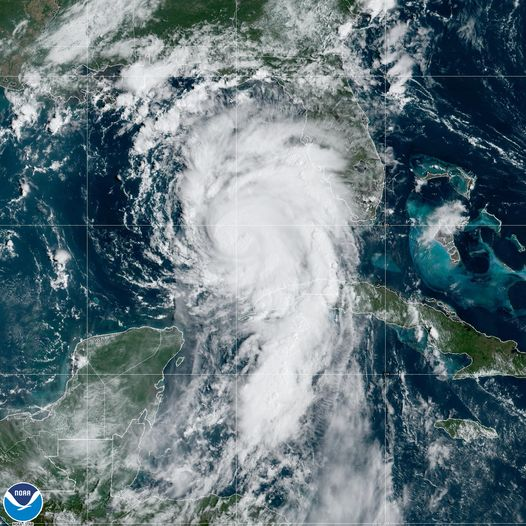
Hurricane Idalia 2023

Florida's hurricane season is from June 1 to November 30. These five months are also the wet season here when we receive up to 70% of our annual rainfall. Our hot wet summers make it difficult to grow some vegetables like sweet basiltomatoes and most members of the squash family, but growing crops is not the topic for this post.

As I'm writing this, Hurricane Idalia is pummeling the west coast of Florida. Florida is subjected to more hurricane activity than other states because the 1,350 mile-long coastline, which is surrounded by warm waters. When sea surface temperatures are above 82˚F, this warm water sustains and intensifies tropical storms that may strengthen into hurricanes. This year the Atlantic Ocean temperatures reached as high as 101˚F just off the east coast of Florida. So it's not surprising that we have been struck by a Category 4 hurricane.

Friday, April 22, 2022

The value of trees

 An appreciation of trees
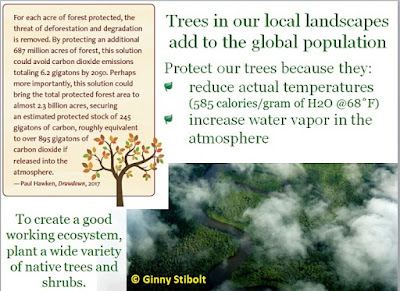
Trees in our yards and in our communities add to the global
population, which is crucial for slowing down climate change.

Here are just some of the many ways that trees are important not only in our urban and suburban neighborhoods, but also for the whole planet:

- Trees actually cool the air through transpiration. A mature deciduous tree like an oak will transpire more than 400 liters of water on a hot summer's day. In the process of liquid water evaporating (going from liquid to gas) the air is cooled. At 68˚F each gram of water that evaporates, cools the air by 585 calories. Transpiration: Forests' most important service

- Trees sequester carbon, by absorbing carbon dioxide (CO2) a long-lasting greenhouse gas, through the process of photosynthesis where they remove carbon dioxide from the air to make sugars, which are then stored in the various plant tissues. A typical hardwood tree can absorb as much as 48 pounds of carbon per year. This means it will sequester approximately 1 ton of carbon by the time it reaches 40 years old. Carbon sequestration

- Trees produce oxygen through photosynthesis, but trees and all the other organisms in the forest absorb most of that oxygen to live. Also read Transpiration: Forests' most important service where I talk about three cycles in the forest: Carbon, Oxygen, and Water.

- Trees remove carbon monoxide (CO) and other air pollutants from the air. They are absorbed primarily through stomata (pores) on the leaves where they diffuse into intercellular spaces and may be absorbed by water films to form acids or react with inner-leaf surfaces. Trees can remove significant amounts of air pollution in cities, where it is often concentrated. More information on this from the EPA.

Saturday, May 1, 2021

Our freedom lawn


We let our lawn go wild!

When we first moved into our house, the lawn-care guys who had worked for the former owner stopped by to offer to continue their services. When I refused, they said that without their poisons (fungicides, insecticides, and herbicides) and their specially-formulated fertilizer and weed & feed applications that our lawn would die. Well, as it turns out, a few months later some brown spots did develop, but they were soon taken over by other plants, which those lawn guys would probably have condemned as "weeds."

Monday, October 12, 2020

An unexpected drainage project

A complex location, with a raised sprinkler head, a newly
reinstalled downspout, and the access to the septic system.

Rain barrels on the move

We moved the three rain barrels that we'd installed at the back of the garage. Initially, years ago, they were elevated on a wooden platform, but when the wood gave out due to stress from all that weight, we reinstalled them in the same place on separate cinderblock towers. I wrote about them here: Three more rain barrels and here: Reworking the elevated rain barrels.

Well, since there was no cross bracing between the towers, the cinderblocks tipped and sank into the soil at different rates. This caused a problem with the plumbing since the barrels are connected together to have one spigot. 

My husband disassembled barrels and reinstalled the downspout for this end of the gutter that runs along two sides of the garage. The other end feeds into two different rain barrels. 

The three barrels sat unused through the summer, but the dry season was coming and I'd be growing a large selection of cool-weather crops and I'd need the capacity of those three barrels. In looking at this location we could not install a concrete pad to provide more stability because the main septic pipe from the house runs through the area. We decided to move barrels to the north side of the garage where there was already a concrete pad and to move the ten-foot gutter to gather the water.