Showing posts with label larval food sources. Show all posts

Monday, June 1, 2026

Coonties: Florida's only native cycad & only Atala butterfly host plant

Coontie is a popular native for parking lots
like this hospital lot in Jacksonville, because it
doesn't need trimming to maintain this height.

Coontie (Zamia integrifolia), a beautiful & unique plant native to most of Florida & some Caribbean islands, has an interesting history of over exploitation & the near extinction of the Atala butterfly (Eumaeus atalathat depends on this plant as its larval food source. Today, coontie is widely planted in all of Florida because it's attractive, drought-tolerant, salt-spray tolerant, plus it grows in poor soil & does not need trimming. 

Coontie is a Cycad

Cycads are ancient plants that have a fossil record that shows that they have not changed much in the last 68 million years. They are gymnosperms, which means naked seed. (Pines are also gymnosperms.) Angiosperms, the flowering plants with their enclosed ovaries and their pollinators such as bees & butterflies developed much later. 

Cycads bear pollen and ovaries in fleshy cone-like structures at ground level on separate male and female plants. They are pollinated by beetles and the coonties use heat in the cones at different times to attract the beetles to the male cones and then to travel to the heat in the female cones. This is called thermogenesis.

Thursday, May 1, 2025

Sweetbay magnolia, a lovely tree with highly scented flowers

The beautiful sweetbay magnolia flower
is pollinated by beetles.

The sweetbay magnolia (Magnolia virginiana) is lovely, mostly evergreen medium-sized tree with leaves that are dark green on top with silver undersides. It has beautiful, fragrant flowers and bright red fruits. It is tolerant of flooding, even with brackish water. It grows best in acid soil in full sun or partial shade.

It provides excellent habitat for wildlife. While it's pollinated by beetles, a wide variety of birds and other wildlife consume the fruits, plus it's the larval food source for several butterflies including the Spicebush Swallowtail (Papilio troilus) and the Eastern Tiger Swallowtail (Papilo glaucus). It should be planted much more often.

Monday, July 1, 2024

Winged sumac, a useful understory shrub

A small winged sumac in bloom, which
attracts a wide variety of pollinators.

Winged Sumac (Rhus copallinum) is a deciduous, compact, densely growing, colonizing shrub that is native to all of Florida and the eastern half of North America. It can grow to 10 to 25 feet tall and nearly as wide, although the ones in our yard are much smaller than that. They will grow in a wide variety of situations, but they do best in full sun or partial shade and require good drainage. 

This plant could be used in a hedge row with a variety of other shrubs and is a good choice for naturalizing at the edge between wooded and open areas. Keep in mind that it will be bare for a few months in the winter. It can spread quite some distance via rhizomes or underground roots, so keep that in mind when choosing planting sites.

Sunday, October 1, 2023

Why talking about native plant landscapes is so important

Consumers are presented with this array of mostly
nonnative plants in full bloom to plant so their yards can
decorated with plants at peak bloom all the time.

Where are the native plants?

New homeowners and beginning gardeners find displays similar to this photo that I took at a big box store a few years ago. It's filled with mostly nonnative annuals in full bloom. Each tray is not too expensive, but after they fade in a couple of months, people are expected to come back to replace them with the next set. 

Examples in garden magazines and gardening TV shows with their instant landscapes imply that garden installations are events, and not ongoing projects that develop over the years.

Thursday, June 1, 2023

Dill is a beautiful, easy-to-grow herb in Florida

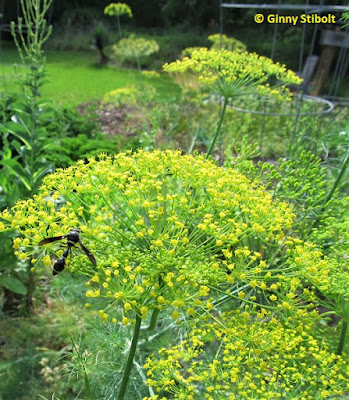
Pollinators love dill flowers.

Dill (Anethum graveolens) is a fast-growing, cool-weather annual with a long taproot. It provides both a classic herb and a spice--the leaves are called dill weed, and used fresh or dried as a herb in salads or as a garnish, while the seeds are used as a spice for pickling or in potato and pasta salads. Dill is native to the Mediterranean region, but it's grown world wide.

The majestic dill flower heads can reach fourteen inches across. They attract a wide variety of pollinators, and importantly for organic gardeners, dill attracts the small parasitoid wasps that prey on tomato worms and other garden pests. 

All the above-ground parts of the dill plant are edible. The leaves and the seeds are most often harvested, but you can also eat the flowers and the stems. 

Taxonomic note: The Kew Garden's Plants of the World Online database considers dill (Anethum graveolens) and several other related species to be synonyms of false fennel (Ridolfia segetum). I have not found other organizations joining in on this lumping of species as yet, but there may be a dill name change in the future.

Tuesday, March 1, 2022

Red maples in Florida

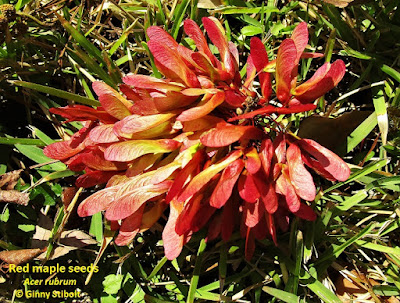
A large clump of maple seeds. It readily reseeds.

Red maples are versatile trees

The red maple (Acer rubrum) is native to most of Florida and its range also includes almost all of eastern North America including Canada. According to the U.S. Forest Service, it's one of the most abundant trees in this range, because it grows well in a wide variety of habitats and because it's easy to grow and has reliable fall color even in Florida, it is widely planted. It will grow in both wet and dry soil, but in the southern part of Florida it's mostly found in wet soils. While it prefers some acidity, it tolerates a variety of soil types.

Friday, October 1, 2021

Removing invasive plants costs Florida $45 million per year

Mimosa tree (Albizia julibrissin),
a Category I invasive in all of Florida.

Yet, many of these plants are still for sale

How did we get into this situation?

A few hundred years ago, once world travel was readily available, many plants and animals were transported from their native habitats where natural checks and balances evolved over millennia so that predator & food sources were in balance. (I will be talking about plants in this post, but invasive animal species are also a huge problem in Florida.) 

People moved thousands of plant species for a number of reasons:
- to bring food crops with them as they settled into new places.
- they collected beautiful plants from around the world to plant in gardens as a novelty or for prestige.
- Some plants were imported for their utility such as stopping erosion (such as kudzu (Pueraria montana)) or building fast-growing hedges (such as, Brazilian pepper (Schinus terebinthifolia)).
- Many non-native plants have been favored in the landscaping industry because most local insects and other critters do not feed on them, so they are easier to grow and sell, because they "look good."
and...
- Sometimes the plants were introduced to new regions by accident as hitchhikers with other plants or with other products that were being transported.

What is "invasive" and how is that status determined?

Saturday, June 29, 2019

An update: red bay trees that died back from laurel wilt disease in 2008.

Three months before the red bay tree by the
pond turned brown, seemingly overnight,
two pileated woodpeckers gave warning
that bugs were infesting the tree.


Back in 2008, we were shocked when all the red bay trees (Persea borbonia) in our yard suddenly turned totally brown. One day they looked fine, the next day their leaves were all dead. After doing some research, I found that the cause for this was the laurel wilt disease, which was carried by the redbay ambrosia beetle, a tiny insect that entered this country in pallet wood from Asia in Savannah, Georgia in 2004. The beetle carries a fungus that blocks the xylem cells so the water stops flowing through the trees. This is why the symptoms are so sudden, because without the flow of water, the tree cannot function. The fungal disease is known as the laurel wilt disease. Other members of the Laurel family (Lauraeae) that are susceptible to this disease include both natives such as sassafras and spicebush, and non-natives such as avocado and camphortree. Here is a link to the article I wrote back then: Red bay trees are dying.

Wednesday, September 19, 2018

Wide-row beds and other adventures in fall gardening

Wide-row vegetable beds

My wide-row method of planting is similar to Square-Foot gardening where seeds or plants are spaced so crops have room to grow, but little or no room for weeds. The trenches between the rows allow for good drainage and can be sized so that a larger crop has room to spread.


 Getting ready for fall planting. I size the beds and the trenches to suit the crops. In the upper left I have a small swale with a wire cage for a fall crop of cucumbers. In the background some Malabar Spinach and a trellis for some yard-long or asparagus beans. 

Sunday, April 29, 2018

Our Blue Marble

The first Earth Day was April 22, 1970. There were many environmental problems in those days, but these problems had been building up for decades. (See this NY Times summary of our status at that time: America Before Earth Day.) Those were NOT, for many reasons, the “good old days.”

View of the whole planet changed our perspective and we started Earth Day. It was MUCH needed at that time.
What had happened the previous year, was that we had seen pictures of our beautiful planet from the moon. The Apollo Astronauts called it a "Blue Marble." That name and that vantage point from afar provided a perspective of how beautiful and fragile our only planet was. Politicians of every stripe worked at every level to put regulations in place to reverse the rampant pollution of our air, water, and land. The regulations have been amazingly effective and air, water and soil pollution has been drastically reduced. Those regulations are still needed today—maybe  more than ever because there are billions more humans all competing our planet’s resources. It is unconscionable that right-leaning politicians, at all levels of government, have been working in many ways to undo environmental regulations that have been put in place during the last two decades to clean the air and the water. 

Saturday, July 1, 2017

All-American landscape filled with natives

What could be more patriotic than a native landscape that supports Mother Nature??

Belfast castle garden is an example of a non-native and
unsustainable landscape. This is NOT authentic to America.
For far too long, the standard landscaping in our country has ignored the plants that belong here. Maybe it's a throwback to the European upper class castles where impossibly maintained formal gardens and the most exotic plants showed how much wealth they had. This landscape style is not only difficult to maintain, it's also not authentic to America.

It's time for a more patriotic approach...

The All-American Landscape
filled with regionally authentic plants 


Tuesday, September 20, 2016

Just say no to seasonal plantings

Nothing says fall like pumpkins, gourds, and mums
~ ~ ~
 

Don't plant the mums.

Don't you just love these fall displays? Can't you almost taste the hot apple cider?

These gorgeous mums have been raised so they are at their peak right now. But if you buy them, don't bother putting them in your garden. They'll look good for only a few weeks, if you're lucky. Treat them like bouquets and drop their pots into some nice containers or hanging baskets so you can enjoy them. Compost them when they go by.

The problem with seasonal plantings


The tradition varies by region, but it usually goes something like this: mums in the fall. pansies in the winter, begonias or coleus in the spring and thirsty impatiens in the summer.

This means that several times a year you will be disturbing the soil which prepares the soil for weeds, either from the soil's seed bank or from newly dropped seeds. This disturbed soil is more subject to droughts. The soil microbes have to readjust after being disturbed.

Wednesday, August 17, 2016

Soap destroys plants' defenses

How to fight aphids on milkweed?

We plant milkweeds to encourage the monarch butterflies, not only for the nectar, but also because milkweed is the ONLY larval food for the monarch caterpillars. But milkweed also attracts aphids...
Non-native scarlet milkweed (Asclepias curassavica)*. Notice all the yellow aphids on the stems.
I was focused on the monarch when I took the above photo, but it's obvious that my milkweeds had become infested with aphids. I just allowed the aphids to stay. Eventually some ladybugs came in, but the plant is better off without any "treatment" from the gardener.

Often the "expert" advice is to spray homemade concoctions with soap or detergent to get rid of the aphids. Don't do it!