Showing posts with label Growing edibles. Show all posts

Thursday, January 1, 2026

Florida Betony

Florida betony develops ridged tubers that
look sorta like a rattlesnake tail and are edible.

Florida betony (Stachys floridana) is an aggressive perennial wildflower. Most botanists think that it was originally endemic to Florida, but now has spread to most of the Southeastern states from Virginia to Texas. It's a member of the mint family (Lamiaceae) and has the typical square stems and opposite leaves along the stems. The beautiful bilateral flowers range from whitish to purple arranged on a spike. It does best in damp soils.

The tubers are edible

It's also known rattlesnake weed because of its rattle-like tuber. Florida betony tubers are edible when harvested in the spring when they are firm and white, but only if the area has not been poisoned with lawn-care chemicals. They have the crispness of a water chestnut with a taste reminiscent of a very mild radish. Most people don't eat them later in the season when they turn tan or yellow and are not as crisp.

Saturday, November 1, 2025

This year's roselle crop was amazing!

The roselle was almost as tall as the house.

This year's roselle (Sabdariffa gossypiifolia formerly Hibiscus sabdariffa) crop was amazing even though we were out-of-town for almost 2 months starting at the end of March and again for a month in midsummer. I planned for survival of the roselle shrubs during these trips in a couple of ways. 

- I'd planted them on the back (house-side) of a 10'-long swale and surrounded the area with several wire tomato cages to keep them upright and also to protect them from the deer. 
- The bottom of the swale had been enriched with several loads of kitchen scraps when the roselle shrubs still were small. (Read this article for details on composting in place.) 
- I'd planted tomatoes mostly to one side of the roselle bed, but then strung the sprawling tomato plants onto the front tomato cages. This was also to keep the deer away, because they do not favor tomatoes.
- Before we left on our trip in March, I placed the end of the rain barrel hose into the swale and left the rain barrel on a very slow drip. This way all the water from that downspout was used to irrigate the roselle. 
- Before we left on the second trip, I propped up the plants and tied them together to two 12' poles and to the house. 

Wednesday, October 1, 2025

Food-from-scraps

I prepare a whole row for come-again crops.
So far this year I have two starts: celery &
romaine lettuce.

Instead of throwing away or composting the bases of store-bought celery, cabbages, leaf lettuces, and other cool-weather crops, you can grow new food. The base must include a root-bearing zone. This is a fun project for kids, because you see results in just a few days.

As, I prepare wide rows for my fall and winter crops, I also prepare a food-from-scraps row. It's usually a fairly narrow row about a foot wide. First, I bury kitchen scraps and compost down the middle of the row and leave a shallow swale on the surface so that water stays in place and soaks into the soil. Then I mulch the row with pine needles. Here's link to my wide-row article for more detail & photos.

So far this year, I have two starts in this row, celery and romaine lettuce. Over the years, I have had the best success with celery, so much so, that I never plant it as a crop from seeds or plants. Cabbage has also been quite reliable and I end up harvesting the come-again cabbage leaves well before my regular cabbage crops mature.

Sunday, September 1, 2024

Grapes (Vitis spp.)

A muscadine grape (Vitis rotundifolia 'Alachua')
Credit: Ali Sarkhosh, UF/IFAS

Florida's grapes

There are six species of grapes that are native to Florida, while some have small ranges, grapes are found in all parts of the state. 

- Summer grape (Vitis aestivalis)
- Florida grape (Vitis cinerea var. floridana)
- Catbird grape (Vitis palmata)
- Muscadine (Vitis rotundifolia)
- Calloose grape (Vitis shuttleworthii)
- Frost grape (Vitis vulpina)

The muscadine grape is native to all of Florida and from Delaware to eastern Texas. This is grown as a sustainable crop in Florida and has been bred so that this normally dioecious plant (with separate male and female plants) is self-fertile or monoecious.

Wednesday, May 1, 2024

Composting in place: Part 2

I scored a huge load of wood chips the
other day--mostly pines (with needles)
& oaks. This close to our 30th
load since 2004.

I wrote "Enrich soil for crops by composting in-place" back in 2019 about how I build soil and our raised beds for growing our vegetables, which includes the whole process from building the beds (without hard sides) to trench composting to add additional organic materials to the soil. While no gardener can claim 100% success rate in growing veggies, over all I've been quite successful over the years with these wide-row beds. Plus, this article has been one of the most visited.

This article is a follow-up to that piece and it's also centered around our vegetable beds, but this time I cover what's between the beds and how beautifully rich soil is also created there.

A new arborist chip dump

On our morning walk, I saw a tree company getting ready to work a couple of streets over from ours. I walked back over there and asked for their load of chips, they were happy to do so. They were just getting ready to drive their truck to the dump, as I walked the 1/2 mile back home, the truck passed me and I explained where to dump them, but the driver already knew where to go because he'd dumped loads there before. 

Friday, March 1, 2024

Carrots: a most satisfying cool-weather crop

Carrots are native to Europe and parts of Asia and
Africa, but now have escaped around the world and
those wild carrots are known as Queen Anne's lace.

Carrots (Daucus carota) are in the carrot family Apiaceae. While this plant family includes quite a few well-known and economically important crop plants as anise, caraway, carrot, celery, chervil, coriander, cumin, dill, fennel, parsley, and parsnip, there are also a few highly poisonous species, such as poison hemlock, water hemlock, spotted cowbane, and fool's parsley. 

The defining characteristic of this family is the inflorescence, the flowers nearly always aggregated in terminal umbels, that may be simple or more commonly compound. The other name for this family is Umbelliferae. 

Thursday, November 23, 2023

Pumpkin, carrot, onion soup recipe

A delicious, rich, thick pumpkin carrot soup

This is a delicious, hardy soup using one of our many Seminole pumpkins. My husband and I worked together on this soup, which was three dinners for the two of us and two lunch servings. (See my Seminole pumpkin article, which has more recipes for this versatile squash.)

Ingredients:

1 small pumpkin, seeded, peeled and cut into 1/2" cubes*
6 medium carrots, peeled and cut into 1/2" cubes 
2 large sweet onions, coarsely chopped
1/3 cup grated radishes*
1 tablespoon of fresh rosemary leaves, chopped*
1 teaspoon of fresh oregano leaves*
1/3 cup of garlic chives, chopped*
1/2 teaspoon of dill seed*
1 cup plain Greek yogurt added to the soup and more as garnish
8 cups of water
2 eggs, beaten
enough olive oil to sauté the herbs and the onions
Freshly ground black pepper
2 tablespoons of dill, chopped for garnish*

*Fresh from the garden (except for the dill seed, which collected last spring)

Thursday, June 1, 2023

Dill is a beautiful, easy-to-grow herb in Florida

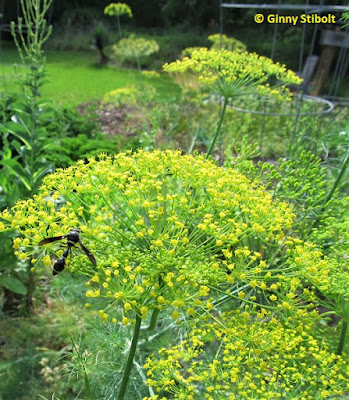
Pollinators love dill flowers.

Dill (Anethum graveolens) is a fast-growing, cool-weather annual with a long taproot. It provides both a classic herb and a spice--the leaves are called dill weed, and used fresh or dried as a herb in salads or as a garnish, while the seeds are used as a spice for pickling or in potato and pasta salads. Dill is native to the Mediterranean region, but it's grown world wide.

The majestic dill flower heads can reach fourteen inches across. They attract a wide variety of pollinators, and importantly for organic gardeners, dill attracts the small parasitoid wasps that prey on tomato worms and other garden pests. 

All the above-ground parts of the dill plant are edible. The leaves and the seeds are most often harvested, but you can also eat the flowers and the stems. 

Taxonomic note: The Kew Garden's Plants of the World Online database considers dill (Anethum graveolens) and several other related species to be synonyms of false fennel (Ridolfia segetum). I have not found other organizations joining in on this lumping of species as yet, but there may be a dill name change in the future.

Sunday, January 15, 2023

Organic Methods for Vegetable Gardening in Florida: 2nd Edition

Order directly from our publisher:
University Press of Florida 

Melissa and I worked with University Press of Florida to improve, update, and reorganize our book. The photos, including many new ones, are now located throughout the book, not just in the center, which will make it much easier to read. We've explained our process in the new preface included here for your information.

Preface to the Second Edition 

Much has happened in plant science and organic gardening techniques in the almost 10 years since we began researching and writing the first edition of this book, so we agreed to spend some time to revisit and update the content for this edition. We were eager to work on this project so that Florida’s vegetable gardeners would have easy access to this new information. 

Thursday, December 1, 2022

Fall cucumbers

Cucumber (Cucumis sativus) is in the squash family (Cucurbitaceae) and is more closely related to melons than the squashes, which are in the Cucurbita genus. It's native to India but has been under cultivation as a crop for about 3,000 years. Now, it is widely cultivated around the world.

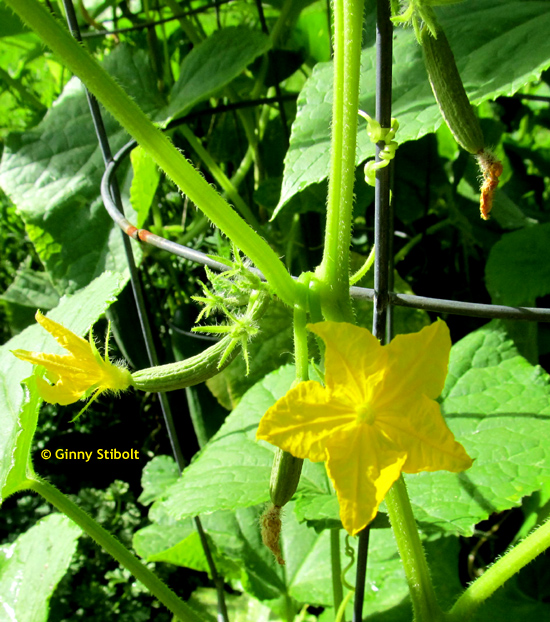
Male and female cucumber flowers. The female flower sits atop a small, preformed fruit. If the flower is not adequately pollinated, then the fruit will not expand, turn yellow, and fall off the vine.

Tuesday, November 1, 2022

Marigolds

Beautiful marigolds!

Inchworm by Danny Kaye

Inchworm, inchworm (two and two are four)
Measuring the marigolds (four and four are eight)
You and your arithmetic (eight and eight are sixteen)
You'll probably go far (sixteen and sixteen are thirty-two)

Inchworm, inchworm (two and two are four)
Measuring the marigolds (four and four are eight)
Seems to me, you'd stop and see (eight and eight are sixteen)
How beautiful they are (sixteen and sixteen are thirty-two)

Marigolds have been under cultivation for centuries

Monday, August 1, 2022

Okra: a fast growing, heat-loving crop

Burgundy okra is a beautiful and tasty addition 
to your summer vegetable garden.

Okra (Abelmoschus esculentus) is a fast growing, heat-loving annual crop native to the southwestern highlands of Ethiopia along the White Nile River. It has been grown in various parts of the world and was most likely brought to the Caribbean Islands and the southeastern states by enslaved peoples from Western Africa. At first, it served as a subsistence food for slaves, but was then accepted as a southern favorite. Thomas Jefferson grew it in his garden at Monticello, Virginia in the 1780s.

Wednesday, June 1, 2022

Growing onions and garlic in North Florida


Onion planting day: November 26

Onions and garlics

Both onions and garlics are in the genus Allium, which contains several crops that are divided into two groups:
1) Onions, which have hollow leaves and 
2) Garlics, which have flat, solid leaves. (*See note below on the family.)

Onions (Allium cepa) are treated as a long-season annual in Florida. Botanically, they are biennials, where in a natural habitat, they would grow leaves and form a bulb the first year, go into dormancy, and the second year they would use the stored energy in the bulb to form flowers, which are borne on a specialized stem called a scape. We interrupt this cycle by harvesting as the plant goes dormant and when the bulb is at its maximum size. 

Thursday, March 31, 2022

Growing parsnips in North Florida

Wear gloves to harvest parsnips, because the foliage is toxic.

Parsnip (Pastinaca sativa) is a biennial that is similar to carrots (and is in the same family) where the crop is the tap root. In early fall, I planted the seeds directly into deeply prepared garden soil. I planted my first carrot seeds at that time as well. I just barely covered the seeds with fine soil and watered them and the carrots thoroughly several times a week. The parsnip seeds took a week or so longer to germinate than the carrot seeds. 

I knew that they have a fairly low germination rate and that the seeds don't stay viable until the next season, so I planted the whole seed package in a half row about 24" x 18". I thinned the seedlings once so that there would be adequate room for root expansion. Some gardeners germinate the seeds in between damp or wet paper towels to have more control. Those that germinate can then be transplanted into the garden at just the right distance from each other. Do this early, only a few days after germination, because if you wait too long, you'll disturb their roots, and they may not recover. 

Warning! The shoots and leaves of parsnip must be handled with care, as its sap contains phototoxic chemicals that can cause blisters on the skin when it is exposed to sunlight. Toxicity can also affect livestock and poultry, so wear gloves when weeding, thinning, or harvesting this crop, and then compost the foliage.

Tuesday, February 1, 2022

Salad burnet: an easy-to-grow perennial crop

Salad burnet (Sanguisorba minor) is a perennial crop in the rose family (Rosaceae) that is native to all of Europe, northern Africa and also in southern Africa. It's easy to grow from seed and it reseeds. It's best to plant this with other perennial crops and herbs so it does not get in the way during crop rotations.

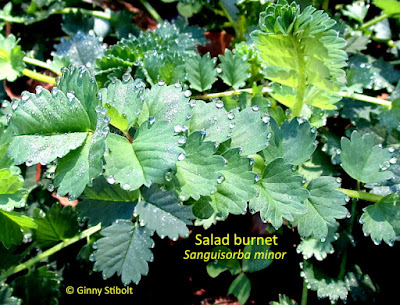
Salad burnet leaves in the morning with guttation* drops on
the ends of all the leaf serrations.

Monday, November 1, 2021

Roselle: Florida's cranberry

Roselle (Sabdariffa gossypiifolia formerly Hibiscus sabdariffa)

The calyces subtend and support the petals. The flower lasts for only one day and when the petals fall off, the sepals begin to swell to surround the developing fruit. 

The five overlapping petals of the roselle flower are pale yellow tinged with burgundy on the edges and becoming deep burgundy in the center of the flower where the pistil emerges.

The mallow family: Malvaceae

Saturday, September 4, 2021

Wild sweet basil

Wild sweet basil has lavender flowers
unlike sweet basil and lime basil which
have white flowers.

Florida's native basil

Update Feb. 2024: It turns out that the basil I described here in this article had been misidentfied and had been in the native plant trade for some years. But it turns out that it was holy basil (Ocimum tenuiflorum) native to Asia and Australia. When I obtain the REAL Florida native, I'll update this article. Sorry.

Wild sweet basil (Ocimum campechianum) is warm-weather herb related to sweet basil (O. basilicum) and lime basil (O. americanum). (Lime basil can tolerate Florida's hot wet summers, which I wrote about in two previous posts.) Unlike those traditional basils so popular in the Mediterranean cooking, which are native to India, Africa and Southeast Asia, this wild basil is native to the southernmost Florida counties, the Caribbean islands, Mexico, Central America, and most of South America.

Since we live in northeast Florida, this plant is not a true native here, but South Florida is MUCH closer to home than Africa or India, so this species of basil would be a regional native that should be better adapted to our climate with our hot, wet summers. Sweet basil often suffers from fungal diseases during our wet summers. 

Monday, July 5, 2021

Leeks: Growing and using this garlic relative

Freshly harvested leeks have had most of
their leaves chopped off above their fat stems.

Leeks (Allium ampeloprasum) are native to the Mediterranean region and were developed as a crop in Europe and their mild taste makes them a favorite for soups. They form a thick stem at the base that continues fairly high into the plant. The flat, solid leaves are folded and grow on opposite sides of the stem, but no true bulb is formed. Because the leaves are flat, leeks are on the garlic side of this genus and indeed elephant garlic is a cultivar of this species (A. ampeloprasum var. ampeloprasum). The onion side of this genus has hollow leaves like chives.

Monday, June 7, 2021

Bountiful harvests of early summer

Bountiful harvest for a tabbouleh--made
possible because of the pandemic travel ban.
Yellow banana peppers, assorted tomatoes,
curly parsley, purple and white onions,
garlic chives, and bunching onion leaves.

Cooking to the harvests

Because of the pandemic, we haven't been traveling since March 2020, which has resulted in many more crops and harvests that would not have been possible otherwise. Normally, we would have been traveling at various times during this period--mostly to be a guest presenter on cruise ships--so we would not have been able to accomplish this.

Sunday, March 28, 2021

Science-based companion planting

Buy your own copy of Plant Partners
by Jessica Walliser
 at Amazon.

Much has been written about which plants work well together, and often the various human emotions, such as love and hate, accompany these descriptions. Extension agents, university professors, and other scientists had debunked most of the anecdotal benefits of traditional companion planting. 

But now there is new science on using various plants to:
- act as trap crops to lure pests away from crops,
- attract predatory insects that will reduce pest problems on crops,
- add diversity, which may confuse pest organisms.
- reduce weeds,
- increase pollinator populations,
- add nutrients, and more.


Jessica Walliser's new book, "Plant  Partners: Science-Based Companion Strategies for the Vegetable Garden" (published by Storey Publishing) is the winner of a 2021 The American Horticultural Society Book Award. Jessica is a rare two-time winner of this prestigious award and her book compiles this latest research on using plants to accomplish several benefits in vegetable gardens.