Showing posts with label Roselle. Show all posts

Saturday, November 1, 2025

This year's roselle crop was amazing!

The roselle was almost as tall as the house.

This year's roselle (Sabdariffa gossypiifolia formerly Hibiscus sabdariffa) crop was amazing even though we were out-of-town for almost 2 months starting at the end of March and again for a month in midsummer. I planned for survival of the roselle shrubs during these trips in a couple of ways. 

- I'd planted them on the back (house-side) of a 10'-long swale and surrounded the area with several wire tomato cages to keep them upright and also to protect them from the deer. 
- The bottom of the swale had been enriched with several loads of kitchen scraps when the roselle shrubs still were small. (Read this article for details on composting in place.) 
- I'd planted tomatoes mostly to one side of the roselle bed, but then strung the sprawling tomato plants onto the front tomato cages. This was also to keep the deer away, because they do not favor tomatoes.
- Before we left on our trip in March, I placed the end of the rain barrel hose into the swale and left the rain barrel on a very slow drip. This way all the water from that downspout was used to irrigate the roselle. 
- Before we left on the second trip, I propped up the plants and tied them together to two 12' poles and to the house. 

Monday, May 1, 2023

Hibiscus: Plants with the most beautiful flowers

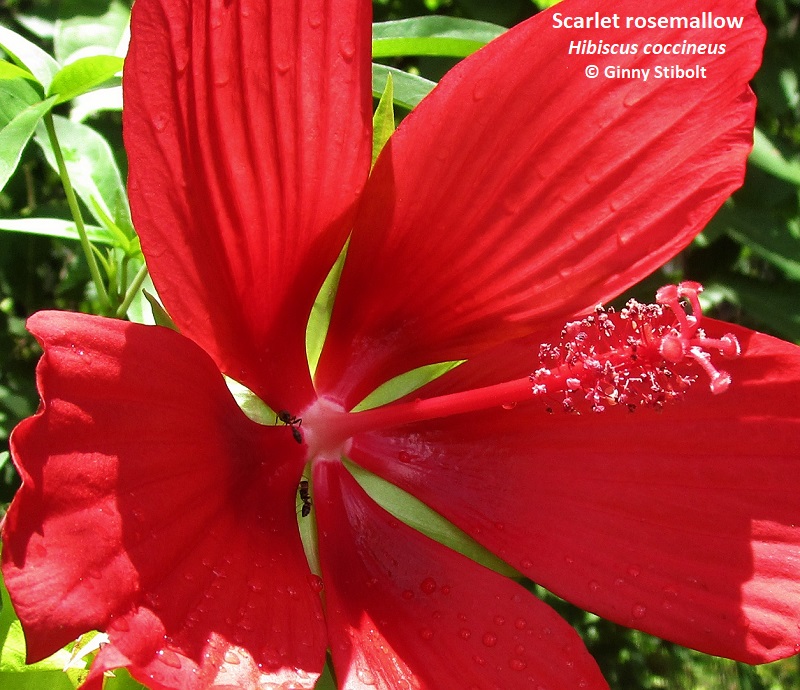
A scarlet rosemallow (Muenchhusia coccineus):
 a Florida native

There are 432 Hibiscus species that are found worldwide, and with their beautiful flowers, many are grown in gardens and some are even used as crops. In general, the flowers are large and showy. (Updatre in June 2026: Some of Florida's native Hibiscus species are now Muenchhus, while some others are Sabdariffa.)

For example, see the scarlet rosemallow in the lead photo. Here there are five green sepals subtending five large red petals. The pistil, the female reproductive part of a plant, is attached to the center of the flower. The pistil is made up of a five-chambered ovary where seeds develop, the style that is a long tube between the ovary and five round stigmas where the pollen is absorbed. A stamen, the male reproductive structure, consists of the anther that holds the pollen, and a stalk called the filament. In hibiscus flowers, the filaments fuse into a tube that surrounds the style. Numerous anthers stick out from the filaments below the five stigmas at the top of the style. The prominent pistil with all those anthers is one reason the hibiscus flowers are so showy.

Monday, November 1, 2021

Roselle: Florida's cranberry

Roselle (Sabdariffa gossypiifolia formerly Hibiscus sabdariffa)

The calyces subtend and support the petals. The flower lasts for only one day and when the petals fall off, the sepals begin to swell to surround the developing fruit. 

The five overlapping petals of the roselle flower are pale yellow tinged with burgundy on the edges and becoming deep burgundy in the center of the flower where the pistil emerges.

The mallow family: Malvaceae