Showing posts with label Wildlife. Show all posts

Sunday, March 1, 2026

The Birds are NOT OK

What is the birds-eye view of your yard
your community?

Birds Aren’t Just Declining.
They’re Declining Faster!

Scientists studying data collected for more than three decades found accelerating losses. The steepest losses in the study, from 1987 to 2021, were seen in Florida, Texas, Louisiana and Arizona. This research offers clues about the causes. Here are links to a gift article in the NY Times that looks at this research and to a WashingtonPost gift article, which both cite the same study.

This research showed a correlation with increased use of pesticides in agricultural regions, but it also linked back to an older study showing that cats cause huge harm to our birds. I wrote about that as well and how controversial this is in this article.

This Red-shouldered Hawk provided its
opinion on how humans treat birds.


BUT...

Whatever the causes for their decline, we are NOT helpless and, as Joan Baez stated, "Action is the antidote to despair."

There are many actions we can take to make our yards and our communities more bird friendly. I've covered this topic from several different angles over the years, so I've gathered some of the most relevant articles here to make it easier for people to up their game at this critical time. The birds need us to act now more than ever.

Thursday, January 1, 2026

Florida Betony

Florida betony develops ridged tubers that
look sorta like a rattlesnake tail and are edible.

Florida betony (Stachys floridana) is an aggressive perennial wildflower. Most botanists think that it was originally endemic to Florida, but now has spread to most of the Southeastern states from Virginia to Texas. It's a member of the mint family (Lamiaceae) and has the typical square stems and opposite leaves along the stems. The beautiful bilateral flowers range from whitish to purple arranged on a spike. It does best in damp soils.

The tubers are edible

It's also known rattlesnake weed because of its rattle-like tuber. Florida betony tubers are edible when harvested in the spring when they are firm and white, but only if the area has not been poisoned with lawn-care chemicals. They have the crispness of a water chestnut with a taste reminiscent of a very mild radish. Most people don't eat them later in the season when they turn tan or yellow and are not as crisp.

Monday, December 1, 2025

Sticks as Mulch

Using sticks as mulch reduces weed growth.

Mulches & mulching

Over the years, I've written about mulching and mulches in my seven books and in various articles: 
- Pine needle mulch (the most read post on this blog)
- Wood chip mulch 
- Too much mulch
- Rock-scaping & more.

But for the past several years, I've also been using sticks as mulch near buildings to reduce weed infestations. Unlike other mulching materials, there's a lot of air or space between the sticks, so there's nothing there for seedlings. Eventually, some weeds that spread via rhizomes or stolons, such as fog fruit (Phyla nodiflora) or Florida betony (Stachys floridana) work their way into the space, but very few seed-spread weeds. 

This type of mulching works well for our yard because have lots of trees. A good time to create a stick-mulch area is after a high-wind event. Yes, we also have several stick piles to create habitat for small birds and various insects, so I don't usually raid those piles for sticks for mulching. 

Tuesday, July 1, 2025

The importance of Oaks

An oak branch in the white oak group

Oaks

Most oaks (Quercus spp.) are hardwood trees and have been used by people over the ages for building structures and boats. The oak fruit is a true nut with a hard shell and a cap, called the cupule, which protects the kernel. The kernel, which consists of two fatty seed leaves, called cotyledons, which surround a small embryo. This is an important food for wildlife and for early humans once they learned how to remove the bitter tannins.

Oaks are divided into two major groups. The white oaks are those with rounded lobes on their leaves and the acorns mature within one season and are less bitter. The red oaks generally have pointed lobes or sharp lobes on their leaves and their acorns stay on the trees for two seasons, so their acorns have more tannins and are therefore more bitter.

Friday, April 4, 2025

Rain gardens in Florida

Stormwater carries pollutants that
end up in our waterways.

Why do we need rain gardens?

Sequestering stormwater reduces pollution of our waterways and of our aquifers. This is because stormwater runoff carries: fertilizers, sediments, plant matter, manures, pesticides, herbicides, salts, oils and other vehicular drippage. 

Pollution that originates from numerous, diffuse sources, such as our yards is called Non-Point-Source (NPS) and the Environmental Protection Agency (EPA) estimates that NPS pollution is the largest threat to our waterways. But, we can reduce NPS pollution from our yards and from our communities by holding or sequestering more rainwater by installing rain barrels and by building rain gardens.

Sunday, December 1, 2024

It's Time to Think Globally, but Act Locally.

www.climatewiselandscaping.com 

Climate change is real!

We are seeing its effects on the weather with more frequent, stronger and slower-moving hurricanes, more severe droughts, more fires, and rising sea levels. But Sue Reed and I did not debate the reality of climate change or what has caused these rapid changes when we wrote our award-winning book, "Climate-Wise Landscaping: Practical Actions for a Sustainable Future." Instead we said, "Let's roll up our sleeves and get to work."

The same thing has happened in the writing of my 7th book with the working title "Living Shorelines for Florida: A Practical Guide for Building Resilience," which will be published in 2025. I and my three coauthors did not debate sea level rise or discuss what the causes might be, but plans for dealing with rising sea levels are included in our various actions and designs for more resilient shorelines.

So what actions can we take and will it make any difference?

While actions we take in our yards and in our communities may seem insignificant, there are many millions of homeowners and communities, and together, we are a powerful force. What follows are some ideas and links to resources for some of the most significant actions. 

Sunday, September 1, 2024

Grapes (Vitis spp.)

A muscadine grape (Vitis rotundifolia 'Alachua')
Credit: Ali Sarkhosh, UF/IFAS

Florida's grapes

There are six species of grapes that are native to Florida, while some have small ranges, grapes are found in all parts of the state. 

- Summer grape (Vitis aestivalis)
- Florida grape (Vitis cinerea var. floridana)
- Catbird grape (Vitis palmata)
- Muscadine (Vitis rotundifolia)
- Calloose grape (Vitis shuttleworthii)
- Frost grape (Vitis vulpina)

The muscadine grape is native to all of Florida and from Delaware to eastern Texas. This is grown as a sustainable crop in Florida and has been bred so that this normally dioecious plant (with separate male and female plants) is self-fertile or monoecious.

Thursday, August 1, 2024

Snags, stumps, and logs provide habitat

Three birds perched on a snag. A ball moss
(Tillandsia recurvata) also lives on this snag.

Dead standing trees are snags. If a snag is located so that it will not hurt people or damage property, leave it standing for its wildlife value. Snags are highly productive sources of habitat that work well in both natural areas and designed landscapes.

Tree basics

The vast majority of organisms on our planet depend upon the life-giving process of photosynthesis. Plants and other organisms with chlorophyll combine carbon dioxide from the air and water with energy from the sun to form sugars and oxygen gas. The plant can then combine the sugars to form starches, fats, enzymes, or whatever the plant needs. 

Photosynthesis: 6CO2 + 6H2O >> C6H12O6 + 6O2

Then most living organisms (plants, animals, fungi, bacteria) take in oxygen and digest the sugars in one form or another to gain energy for life through respiration, a process the equal and opposite of photosynthesis. 

Respiration: C6H12O6 + 6O2  >> 6CO2 + 6H2O 

Since trees normally live for many years, they sequester carbon in their wood and root tissues as long as they live, while the flowers, fruits and leaves store carbon only temporarily until they are eaten or decompose. Much of this decomposing plant matter ends up in the soil. But when a tree dies, the wood begins to break down as bacteria, fungi, insects, and other organisms begin to absorb the wood tissue so they can gain energy for life. As the wood deteriorates, then birds and other larger animals can consume the decomposers and so the carbon-based sugars stored in the wood moves up the food chain. The organisms store the sugars created during photosynthesis, but as they respire and when they die, the carbon is released into the atmosphere.

One note here on carbon sequestration: The soil sequesters 3 to 4 times as much carbon as all the terrestrial plants, including rain forests. Peat is especially important since it can sequester carbon for thousands of years. This is important because the more carbon sequestered means less carbon dioxide, our most abundant greenhouse gas, in the atmosphere and that is good for our only planet. (Read my article on peat moss.)

Monday, July 1, 2024

Winged sumac, a useful understory shrub

A small winged sumac in bloom, which
attracts a wide variety of pollinators.

Winged Sumac (Rhus copallinum) is a deciduous, compact, densely growing, colonizing shrub that is native to all of Florida and the eastern half of North America. It can grow to 10 to 25 feet tall and nearly as wide, although the ones in our yard are much smaller than that. They will grow in a wide variety of situations, but they do best in full sun or partial shade and require good drainage. 

This plant could be used in a hedge row with a variety of other shrubs and is a good choice for naturalizing at the edge between wooded and open areas. Keep in mind that it will be bare for a few months in the winter. It can spread quite some distance via rhizomes or underground roots, so keep that in mind when choosing planting sites.

Monday, January 1, 2024

Ohio Spiderwort: a pollinator-friendly native wildflower

A small fly-like bee was pollinating this flower.

Bluejacket or Ohio spiderwort (Tradescantia ohiensis) is native to most of Eastern North America and to most of Florida. It attracts pollinators, especially bees. Each day, one or two flowers bloom in each flower head. They open early in the morning and then wilt in the afternoon. Each flower head contains twenty or more flowers and new flower heads are formed throughout the long season from early spring to late fall. There is a long blooming season.

There are three other species of spiderworts native to Florida: hairy spiderwort (T. hirsutiflora), longleaf spiderwort (T. roseolens), and zigzag spiderwort (T. subaspera). But the bluejacket has the largest native range and is the one that's most readily available from the native trade.

Spiderworts are monocots and are in the Commelina family (Commelinaceae), which includes 36 genera world wide, but only five occur in Florida. "Spiderwort" refers to the sap which dries into web-like threads when a stem is cut.

Thursday, November 2, 2023

Florida's goldenrods

Goldenrods do Not cause allergies

The insect-pollinated goldenrods (Solidago spp.) with their beautiful flowers have erroneously been blamed for fall allergy season when it's the wind-pollinated ragweed (Ambrosia spp.) with the unnoticeable green flowers that are filling the air with pollen when the goldenrods are blooming. The ragweeds do not need to put any energy into creating beautiful flowers or sweet nectar because the wind will blow anyway. As I understand it, some allergy doctors test people to see if they are allergic to goldenrod pollen even though that pollen is too heavy and sticky to float in the air and there is zero chance of its getting into anyone's nose. 

A swallowtail butterfly is pale in comparison to
the very yellow goldenrod.
Ragweed, the source of the air-borne pollen that gives people hay fever.

Sunday, October 1, 2023

Why talking about native plant landscapes is so important

Consumers are presented with this array of mostly
nonnative plants in full bloom to plant so their yards can
decorated with plants at peak bloom all the time.

Where are the native plants?

New homeowners and beginning gardeners find displays similar to this photo that I took at a big box store a few years ago. It's filled with mostly nonnative annuals in full bloom. Each tray is not too expensive, but after they fade in a couple of months, people are expected to come back to replace them with the next set. 

Examples in garden magazines and gardening TV shows with their instant landscapes imply that garden installations are events, and not ongoing projects that develop over the years.

Monday, May 1, 2023

Hibiscus: Plants with the most beautiful flowers

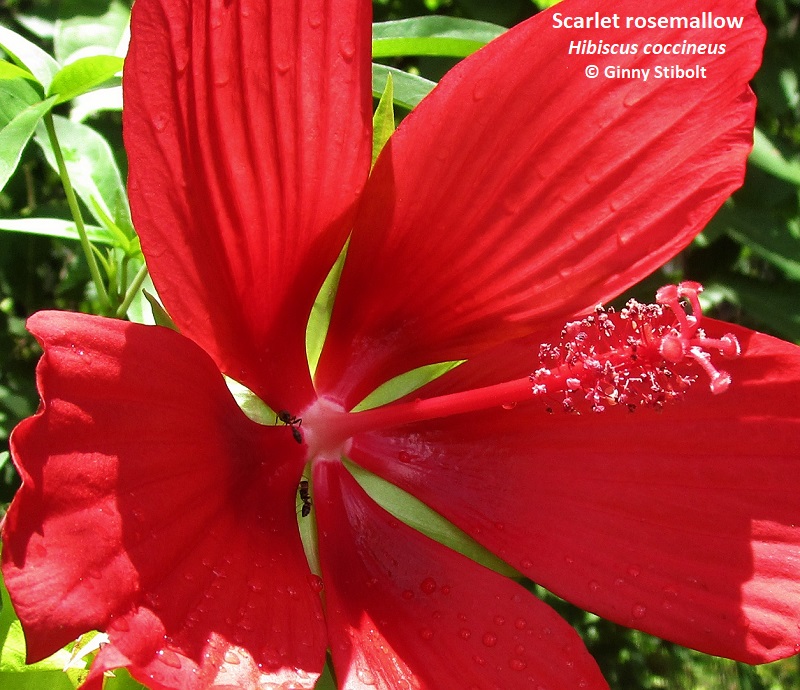
A scarlet rosemallow (Muenchhusia coccineus):
 a Florida native

There are 432 Hibiscus species that are found worldwide, and with their beautiful flowers, many are grown in gardens and some are even used as crops. In general, the flowers are large and showy. (Updatre in June 2026: Some of Florida's native Hibiscus species are now Muenchhus, while some others are Sabdariffa.)

For example, see the scarlet rosemallow in the lead photo. Here there are five green sepals subtending five large red petals. The pistil, the female reproductive part of a plant, is attached to the center of the flower. The pistil is made up of a five-chambered ovary where seeds develop, the style that is a long tube between the ovary and five round stigmas where the pollen is absorbed. A stamen, the male reproductive structure, consists of the anther that holds the pollen, and a stalk called the filament. In hibiscus flowers, the filaments fuse into a tube that surrounds the style. Numerous anthers stick out from the filaments below the five stigmas at the top of the style. The prominent pistil with all those anthers is one reason the hibiscus flowers are so showy.

Tuesday, February 28, 2023

Green-eyes: beautiful and resilient Florida wildflowers

Florida greeneyes bloom nearly year-round and attract
many types of pollinators. Notice how showy the
disk florets are with their extra-long stamens
and their folded-down top edges. 

The greeneyes (Berlandiera spp.) are in the daisy family (Asteraceae) and have the typical flower head arrangement of this family with fertile central disk florets that produce the seeds surrounded by sterile showy ray florets that look and act like petals. They are perennials with a long tap root.

In the case of greeneyes, the flower heads consist of about eight bright yellow ray florets, each with a notched tip, surrounding a head of greenish-yellow tubular disk florets, which is, of course,  why they are called greeneyes. When disk florets open, they reveal maroon anthers and a long yellow stigma, and they smell like chocolate. 

Wednesday, February 1, 2023

The hand of the gardener in native landscapes

Plant more natives!

In 2013, a volunteer beautyberry shrub near the edge of the
lawn is surrounded by several water oaks.

Ecologists and environmental organizations have been urging people to plant more native plants, to build bird-friendly and pollinator-friendly habitat, and to do this by removing at least some of their lawn.

One prime example is Doug Tallamy's HomeGrown National Park where you can register your yard to be part of of this park by replacing at least half of the lawn with native plants.

This is great and I hope that millions of homeowners and other property managers take this step to build native habitat, but there are some important steps to take, especially in urban and suburban areas, to increase the acceptability of these native landscapes. Our yards and our community landscapes, even if they have a good portion of native plants are not wild spaces and will need some regular care. (Actually, I wrote a book on this topic. See below.)

Sunday, January 1, 2023

Red cedar: an important habitat tree

A female red cedar with fruit.

Red cedar (Juniperus virginiana) is medium-sized, dioecious evergreen conifer with female trees that bear waxy, berry-like cones, which many types of birds will eat as the weather grows colder.

While most botanists agree that there is one species of red cedar that's native to most of eastern North America, the old precedent recognized coastal red cedar (J. silicicola) and eastern red cedar (J. virginiana) a bit inland, with a big range from Texas to southern Ontario. This old protocol meant that except for the northern border of Florida's Panhandle, the red cedars native to Florida were the coastal species.

Red cedar is in the cypress family (Cupressaceae), which has world-wide distribution--except for Antarctica. Other members of this family found in Florida are two cypresses: pond cypress (Taxodium ascendens) and bald cypress (T. distichum); Atlantic white cedar (Chamaecyparis thyoides); plus the non-natives: oriental arborvitae (Platycladus orientalis) and white cypress-pine (Callitris glaucophylla).

Friday, April 22, 2022

The value of trees

 An appreciation of trees

Trees in our yards and in our communities add to the global
population, which is crucial for slowing down climate change.

Here are just some of the many ways that trees are important not only in our urban and suburban neighborhoods, but also for the whole planet:

- Trees actually cool the air through transpiration. A mature deciduous tree like an oak will transpire more than 400 liters of water on a hot summer's day. In the process of liquid water evaporating (going from liquid to gas) the air is cooled. At 68˚F each gram of water that evaporates, cools the air by 585 calories. Transpiration: Forests' most important service

- Trees sequester carbon, by absorbing carbon dioxide (CO2) a long-lasting greenhouse gas, through the process of photosynthesis where they remove carbon dioxide from the air to make sugars, which are then stored in the various plant tissues. A typical hardwood tree can absorb as much as 48 pounds of carbon per year. This means it will sequester approximately 1 ton of carbon by the time it reaches 40 years old. Carbon sequestration

- Trees produce oxygen through photosynthesis, but trees and all the other organisms in the forest absorb most of that oxygen to live. Also read Transpiration: Forests' most important service where I talk about three cycles in the forest: Carbon, Oxygen, and Water.

- Trees remove carbon monoxide (CO) and other air pollutants from the air. They are absorbed primarily through stomata (pores) on the leaves where they diffuse into intercellular spaces and may be absorbed by water films to form acids or react with inner-leaf surfaces. Trees can remove significant amounts of air pollution in cities, where it is often concentrated. More information on this from the EPA.

Tuesday, March 1, 2022

Red maples in Florida

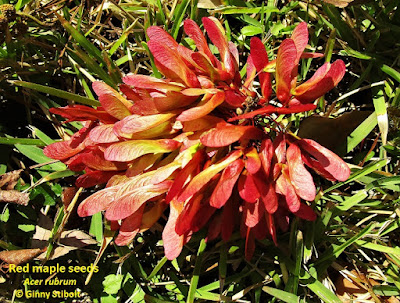
A large clump of maple seeds. It readily reseeds.

Red maples are versatile trees

The red maple (Acer rubrum) is native to most of Florida and its range also includes almost all of eastern North America including Canada. According to the U.S. Forest Service, it's one of the most abundant trees in this range, because it grows well in a wide variety of habitats and because it's easy to grow and has reliable fall color even in Florida, it is widely planted. It will grow in both wet and dry soil, but in the southern part of Florida it's mostly found in wet soils. While it prefers some acidity, it tolerates a variety of soil types.

Friday, October 1, 2021

Removing invasive plants costs Florida $45 million per year

Mimosa tree (Albizia julibrissin),
a Category I invasive in all of Florida.

Yet, many of these plants are still for sale

How did we get into this situation?

A few hundred years ago, once world travel was readily available, many plants and animals were transported from their native habitats where natural checks and balances evolved over millennia so that predator & food sources were in balance. (I will be talking about plants in this post, but invasive animal species are also a huge problem in Florida.) 

People moved thousands of plant species for a number of reasons:
- to bring food crops with them as they settled into new places.
- they collected beautiful plants from around the world to plant in gardens as a novelty or for prestige.
- Some plants were imported for their utility such as stopping erosion (such as kudzu (Pueraria montana)) or building fast-growing hedges (such as, Brazilian pepper (Schinus terebinthifolia)).
- Many non-native plants have been favored in the landscaping industry because most local insects and other critters do not feed on them, so they are easier to grow and sell, because they "look good."
and...
- Sometimes the plants were introduced to new regions by accident as hitchhikers with other plants or with other products that were being transported.

What is "invasive" and how is that status determined?

Saturday, May 1, 2021

Our freedom lawn


We let our lawn go wild!

When we first moved into our house, the lawn-care guys who had worked for the former owner stopped by to offer to continue their services. When I refused, they said that without their poisons (fungicides, insecticides, and herbicides) and their specially-formulated fertilizer and weed & feed applications that our lawn would die. Well, as it turns out, a few months later some brown spots did develop, but they were soon taken over by other plants, which those lawn guys would probably have condemned as "weeds."