Showing posts with label pest management. Show all posts

Sunday, October 6, 2024

Two weeds: one native and one nonnative

While the sharp, hard spikes
 on the seeds hurt our feet and
embed themselves in the
lawnmower tires, this is their
method of dispersal. 

Sand spurs

Six species of sand spurs or sandburs (Cenchrus spp.) are native to Florida. They are true grasses in the grass family, Poaceae.  While native plants are highly recommended for sustainable, climate-wise landscapes, these are not desirable because of the hard and very sharp prickles that cover their seeds. 

They have volunteered in our yard only out by the road where the other plants in our freedom lawn are a bit more sparse and where the neighborhood dog walkers visit on a regular basis. So even though I have cleared out this population of annual plants before, new ones can get a start out there when dogs bring more seeds from elsewhere.

Sunday, September 1, 2024

Grapes (Vitis spp.)

A muscadine grape (Vitis rotundifolia 'Alachua')
Credit: Ali Sarkhosh, UF/IFAS

Florida's grapes

There are six species of grapes that are native to Florida, while some have small ranges, grapes are found in all parts of the state. 

- Summer grape (Vitis aestivalis)
- Florida grape (Vitis cinerea var. floridana)
- Catbird grape (Vitis palmata)
- Muscadine (Vitis rotundifolia)
- Calloose grape (Vitis shuttleworthii)
- Frost grape (Vitis vulpina)

The muscadine grape is native to all of Florida and from Delaware to eastern Texas. This is grown as a sustainable crop in Florida and has been bred so that this normally dioecious plant (with separate male and female plants) is self-fertile or monoecious.

Sunday, January 15, 2023

Organic Methods for Vegetable Gardening in Florida: 2nd Edition

Order directly from our publisher:
University Press of Florida 

Melissa and I worked with University Press of Florida to improve, update, and reorganize our book. The photos, including many new ones, are now located throughout the book, not just in the center, which will make it much easier to read. We've explained our process in the new preface included here for your information.

Preface to the Second Edition 

Much has happened in plant science and organic gardening techniques in the almost 10 years since we began researching and writing the first edition of this book, so we agreed to spend some time to revisit and update the content for this edition. We were eager to work on this project so that Florida’s vegetable gardeners would have easy access to this new information. 

Thursday, December 1, 2022

Fall cucumbers

Cucumber (Cucumis sativus) is in the squash family (Cucurbitaceae) and is more closely related to melons than the squashes, which are in the Cucurbita genus. It's native to India but has been under cultivation as a crop for about 3,000 years. Now, it is widely cultivated around the world.

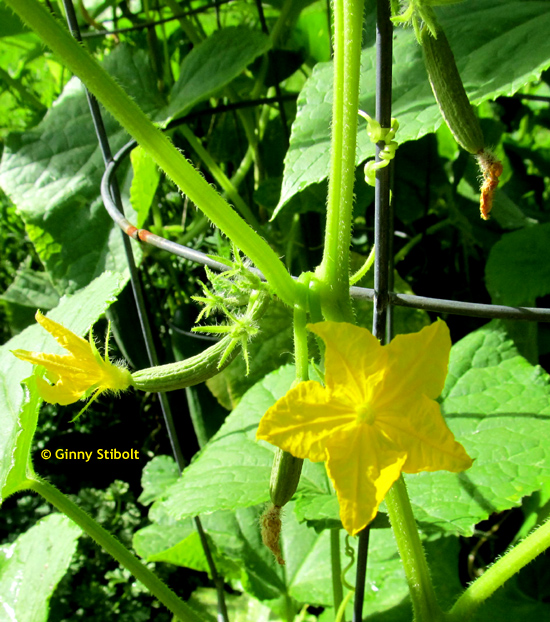
Male and female cucumber flowers. The female flower sits atop a small, preformed fruit. If the flower is not adequately pollinated, then the fruit will not expand, turn yellow, and fall off the vine.

Friday, July 1, 2022

Mangrove spiderlily: an impressive Florida native

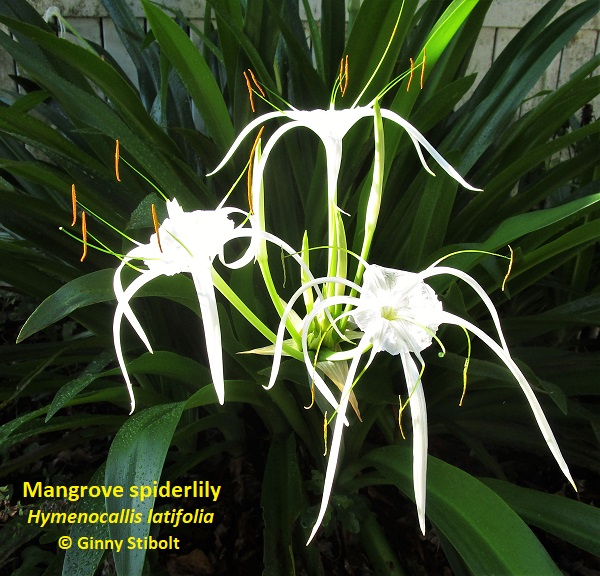
The mangrove spiderlily (Hymenocallis latifolia

The flowers are impressive with orange pollen
and six strap-like tepals emanating from
 a central disk corolla.

The mangrove spiderlily is long-lived perennial in the Amaryllis family (Amaryllidaceae) and its native range is along coastal areas in Central and South Florida and in most of the Caribbean islands. There are 14 species of spiderlily (Hymenocallis spp.) native to Florida, but the mangrove spiderlily is the one that is most often available for sale in the native plant community.

It flowers from late spring through early fall, but in my experience, most of the flowering comes all at once at the beginning of summer. While it's also known as perfumed spiderlily, the ones in my yard have a very light scent. Like many white flowers, they are primarily pollinated by moths.