Showing posts with label harvest-based cooking. Show all posts

Saturday, November 1, 2025

This year's roselle crop was amazing!

The roselle was almost as tall as the house.

This year's roselle (Hibiscus sabdariffa) crop was amazing even though we were out-of-town for almost 2 months starting at the end of March and again for a month in midsummer. I planned for survival of the roselle shrubs during these trips in a couple of ways. 

- I'd planted them on the back (house-side) of a 10'-long swale and surrounded the area with several wire tomato cages to keep them upright and also to protect them from the deer. 
- The bottom of the swale had been enriched with several loads of kitchen scraps when the roselle shrubs still were small. (Read this article for details on composting in place.) 
- I'd planted tomatoes mostly to one side of the roselle bed, but then strung the sprawling tomato plants onto the front tomato cages. This was also to keep the deer away, because they do not favor tomatoes.
- Before we left on our trip in March, I placed the end of the rain barrel hose into the swale and left the rain barrel on a very slow drip. This way all the water from that downspout was used to irrigate the roselle. 
- Before we left on the second trip, I propped up the plants and tied them together to two 12' poles and to the house. 

Friday, March 1, 2024

Carrots: a most satisfying cool-weather crop

Carrots are native to Europe and parts of Asia and
Africa, but now have escaped around the world and
those wild carrots are known as Queen Anne's lace.

Carrots (Daucus carota) are in the carrot family Apiaceae. While this plant family includes quite a few well-known and economically important crop plants as anise, caraway, carrot, celery, chervil, coriander, cumin, dill, fennel, parsley, and parsnip, there are also a few highly poisonous species, such as poison hemlock, water hemlock, spotted cowbane, and fool's parsley. 

The defining characteristic of this family is the inflorescence, the flowers nearly always aggregated in terminal umbels, that may be simple or more commonly compound. The other name for this family is Umbelliferae. 

Thursday, November 23, 2023

Pumpkin, carrot, onion soup recipe

A delicious, rich, thick pumpkin carrot soup

This is a delicious, hardy soup using one of our many Seminole pumpkins. My husband and I worked together on this soup, which was three dinners for the two of us and two lunch servings. (See my Seminole pumpkin article, which has more recipes for this versatile squash.)

Ingredients:

1 small pumpkin, seeded, peeled and cut into 1/2" cubes*
6 medium carrots, peeled and cut into 1/2" cubes 
2 large sweet onions, coarsely chopped
1/3 cup grated radishes*
1 tablespoon of fresh rosemary leaves, chopped*
1 teaspoon of fresh oregano leaves*
1/3 cup of garlic chives, chopped*
1/2 teaspoon of dill seed*
1 cup plain Greek yogurt added to the soup and more as garnish
8 cups of water
2 eggs, beaten
enough olive oil to sauté the herbs and the onions
Freshly ground black pepper
2 tablespoons of dill, chopped for garnish*

*Fresh from the garden (except for the dill seed, which collected last spring)

Thursday, June 1, 2023

Dill is a beautiful, easy-to-grow herb in Florida

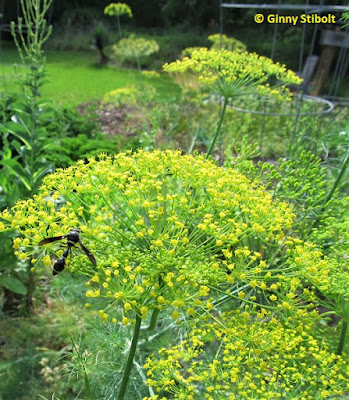
Pollinators love dill flowers.

Dill (Anethum graveolens) is a fast-growing, cool-weather annual with a long taproot. It provides both a classic herb and a spice--the leaves are called dill weed, and used fresh or dried as a herb in salads or as a garnish, while the seeds are used as a spice for pickling or in potato and pasta salads. Dill is native to the Mediterranean region, but it's grown world wide.

The majestic dill flower heads can reach fourteen inches across. They attract a wide variety of pollinators, and importantly for organic gardeners, dill attracts the small parasitoid wasps that prey on tomato worms and other garden pests. 

All the above-ground parts of the dill plant are edible. The leaves and the seeds are most often harvested, but you can also eat the flowers and the stems. 

Taxonomic note: The Kew Garden's Plants of the World Online database considers dill (Anethum graveolens) and several other related species to be synonyms of false fennel (Ridolfia segetum). I have not found other organizations joining in on this lumping of species as yet, but there may be a dill name change in the future.

Thursday, December 1, 2022

Fall cucumbers

Cucumber (Cucumis sativus) is in the squash family (Cucurbitaceae) and is more closely related to melons than the squashes, which are in the Cucurbita genus. It's native to India but has been under cultivation as a crop for about 3,000 years. Now, it is widely cultivated around the world.

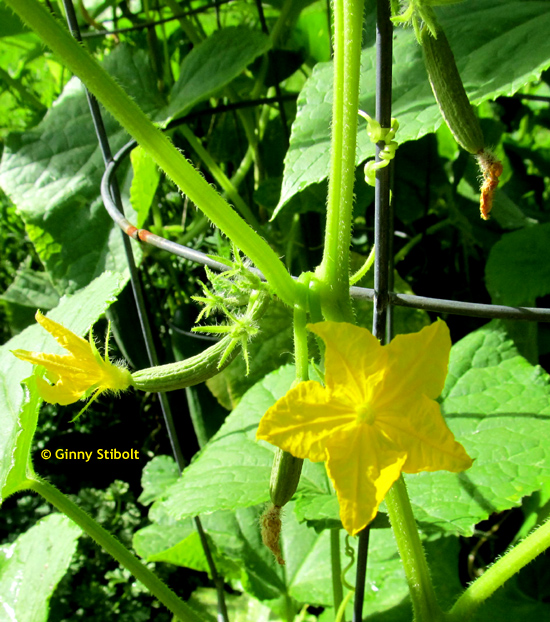
Male and female cucumber flowers. The female flower sits atop a small, preformed fruit. If the flower is not adequately pollinated, then the fruit will not expand, turn yellow, and fall off the vine.

Thursday, March 31, 2022

Growing parsnips in North Florida

Wear gloves to harvest parsnips, because the foliage is toxic.

Parsnip (Pastinaca sativa) is a biennial that is similar to carrots (and is in the same family) where the crop is the tap root. In early fall, I planted the seeds directly into deeply prepared garden soil. I planted my first carrot seeds at that time as well. I just barely covered the seeds with fine soil and watered them and the carrots thoroughly several times a week. The parsnip seeds took a week or so longer to germinate than the carrot seeds. 

I knew that they have a fairly low germination rate and that the seeds don't stay viable until the next season, so I planted the whole seed package in a half row about 24" x 18". I thinned the seedlings once so that there would be adequate room for root expansion. Some gardeners germinate the seeds in between damp or wet paper towels to have more control. Those that germinate can then be transplanted into the garden at just the right distance from each other. Do this early, only a few days after germination, because if you wait too long, you'll disturb their roots, and they may not recover. 

Warning! The shoots and leaves of parsnip must be handled with care, as its sap contains phototoxic chemicals that can cause blisters on the skin when it is exposed to sunlight. Toxicity can also affect livestock and poultry, so wear gloves when weeding, thinning, or harvesting this crop, and then compost the foliage.

Tuesday, February 1, 2022

Salad burnet: an easy-to-grow perennial crop

Salad burnet (Sanguisorba minor) is a perennial crop in the rose family (Rosaceae) that is native to all of Europe, northern Africa and also in southern Africa. It's easy to grow from seed and it reseeds. It's best to plant this with other perennial crops and herbs so it does not get in the way during crop rotations.

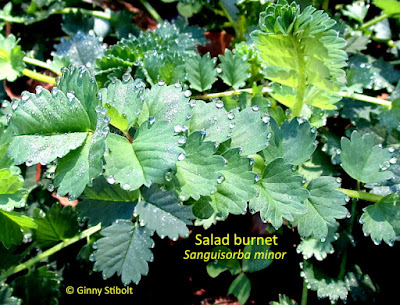
Salad burnet leaves in the morning with guttation* drops on
the ends of all the leaf serrations.

Monday, November 1, 2021

Roselle: Florida's cranberry

Roselle (Hibiscus sabdariffa)

The calyces subtend and support the petals. The flower lasts for only one day and when the petals fall off, the sepals begin to swell to surround the developing fruit. 

The five overlapping petals of the roselle flower are pale yellow tinged with burgundy on the edges and becoming deep burgundy in the center of the flower where the pistil emerges.

The mallow family: Malvaceae

Monday, July 5, 2021

Leeks: Growing and using this garlic relative

Freshly harvested leeks have had most of
their leaves chopped off above their fat stems.

Leeks (Allium ampeloprasum) are native to the Mediterranean region and were developed as a crop in Europe and their mild taste makes them a favorite for soups. They form a thick stem at the base that continues fairly high into the plant. The flat, solid leaves are folded and grow on opposite sides of the stem, but no true bulb is formed. Because the leaves are flat, leeks are on the garlic side of this genus and indeed elephant garlic is a cultivar of this species (A. ampeloprasum var. ampeloprasum). The onion side of this genus has hollow leaves like chives.

Monday, June 7, 2021

Bountiful harvests of early summer

Bountiful harvest for a tabbouleh--made
possible because of the pandemic travel ban.
Yellow banana peppers, assorted tomatoes,
curly parsley, purple and white onions,
garlic chives, and bunching onion leaves.

Cooking to the harvests

Because of the pandemic, we haven't been traveling since March 2020, which has resulted in many more crops and harvests that would not have been possible otherwise. Normally, we would have been traveling at various times during this period--mostly to be a guest presenter on cruise ships--so we would not have been able to accomplish this.

Tuesday, March 2, 2021

The lettuces

Lettuces: fast, easy-to-grow, cool-weather crops

I planted four types of lettuce in this bed: oakleaf,
black-seeded Simpson, drunken woman, & romaine.

Here in North Florida, we grow our cool-weather crops right through the winter. At the end of September, I planted four types of lettuces in a bed next to the house and also planted a curly parsley row there as well. The lettuces were oakleaf, black-seeded Simpson, drunken woman (which was new for us), and romaine. They all did very well, but the romaine gave us the longest and best harvest. I was remiss in not taking any good photos of this bed while it was in its peak. 

With leaf lettuces, you can harvest the outer leaves as needed or you can cut the plant off just above ground level with the hope that the plant would produce new leaves for a second or maybe a third harvest while the weather is still cool, This works best in Florida with varieties of lettuce that are more tolerant of warm weather or ones that are described as "slow-to-bolt."

Wednesday, September 9, 2020

Seminole pumpkin & onion upside-down cornbread

The cornbread as it came from the oven. 
It needs to "rest" for 15 minutes like this.

Cooking to the harvest

Years ago, I'd seen a recipe for upside-down cornbread, so I decided to modify it to include two cups of grated Seminole pumpkin that I needed to use. That old recipe called for baking the cornbread in a cast iron skillet and that would have made it the right shape to flip onto a plate. But my 9" X 12" glass baking dish worked fine and we flipped it onto a cutting board.

I used my standard buttermilk cornbread recipe as a base.  

Monday, May 25, 2020

Lime basil pesto

Lime basil seedlings in my New Zealand
spinach (Tetragonia tetragoniodes) rows.

Lime basil loves Florida's 
hot, wet summers!

Lime basil (Ocimum americanum) is native to Africa, India, and Southeast Asia, not the Americas, despite its species epithet. It has a strong citrus odor and a cross between lime basil and sweet basil (O.basilicum) is known as lemon basil.

Sweet basil, which is the traditional basil for Italian cooking including pesto, is susceptible to fungal diseases once the wet season begins here in Florida.

So, a number of years ago, I bought some lime basil seed from Burpee on the advice that it was more heat tolerant. It was so prolific that it has been self seeding in my edible beds ever since.  Read my previous Lime basil article for more information.

This year I transplanted the seedlings from my okra and New Zealand spinach beds to its own row, so I could keep those crops weeded and have a good basil crop as well.


This is the story from rogue seedlings to pesto.

Thursday, August 8, 2019

Enrich soil for crops by composting in-place

Time to remove more lawn and replace it
with larger edible garden beds.
Several people have requested more information about how I compost in place, so this post includes extreme details.

More lawn removal!

This adventure in gardening began with more lawn removal. In the fall of 2016, I'd created a new bed in front of the rain barrels. It was only about 5' x 4'. Here are the details of "Creating a New Bed."  

April 29, 2019
Over this past cool-weather season I'd grown broccoli and curly parsley in the new bed, which had done fairly well. I keep picking the broccoli florets after the initial big curd harvest, so the broccoli season lasts for a long time, but now they were at the end of their cycle. The parsley would last for a while longer.

Wednesday, September 19, 2018

Wide-row beds and other adventures in fall gardening

Wide-row vegetable beds

My wide-row method of planting is similar to Square-Foot gardening where seeds or plants are spaced so crops have room to grow, but little or no room for weeds. The trenches between the rows allow for good drainage and can be sized so that a larger crop has room to spread.


 Getting ready for fall planting. I size the beds and the trenches to suit the crops. In the upper left I have a small swale with a wire cage for a fall crop of cucumbers. In the background some Malabar Spinach and a trellis for some yard-long or asparagus beans. 

Sunday, December 17, 2017

Holiday Legends of Rosemary

A 9-year old rosemary shrub is 3 feet tall & wide

Rosemary (Salvia rosmarinus formerly known as, Rosmarinus officianalis) is a winter-blooming shrub that grows well throughout Florida. That alone makes it a great choice for your garden. But like a talented actor, rosemary plays multiple roles. It brightens your drought-tolerant landscape, adds flavor to your cooking and aroma to your potpourri. Rosemary has been immortalized in song and classic literature, plus it plays a part in a charming legend of Christmas.

Its waxy needle-like leaves grow from the newer sections of the stems, while the older sections of the stem are covered with a rough gray bark. Rosemary is one of many culinary herbs in the mint family. Others include mints, thyme, marjoram, oregano, sages, monarda, and many others. Plants in our herb gardens produce aromatic chemicals to help to fight off leaf-eating predators, but these properties also add flavor to our cooking and aroma to potpourri mixtures.

Monday, September 25, 2017

End of the Seminole pumpkin season

What a bountiful crop! 

The 3 Seminole pumpkin vines took over the whole 18' x 5' bed. Wow. I'm holding a ripe and a green pumpkin--these babies weigh almost 5 pounds each. I got the feeling that if I stood for too long near one of its many growth points, that it would start to twine around my ankle. :-)

Saturday, August 5, 2017

Reworking the elevated rain barrels

I'd been using these elevated barrels since Feb. 2009.

These 3 elevated rain barrels have been well used over the years, because their placement near the edible gardens means that I have been able to use a hose to water thirsty crops rather than hauling watering cans. My back has been grateful.

Our best growing season here in north Florida is Fall, Winter, and early Spring--these are our dry months, but rarely have the barrels run dry during those times. I also have 3 other rain barrels not too far away, but they have not been set up with a single drain like these. See my post Three more barrels for details on how my husband installed them.

After 8 years, it was time to rework the barrels...

Friday, June 9, 2017

Squash family on our menu

3 different species of bee work a
Seminole pumpkin flower.

The Squash family

There are quite a few important crops in this family (Curcubitaceae), from cucumbers and melons to zucchinis and pumpkins, all members of this family have separate male and female flowers which need to be pollinated--most female flowers need to be visited by pollinators (mostly bees and wasps) 7 to 10 times before a fruit forms. The female flower sits atop a small preformed fruit, while the male flower is borne on a long stalk. If a fruit does not grow after the flower fades and it turns yellow, this usually means that it was not fertilized.

Most squash vines put out several to many male flowers first before the first female flower is formed. My guess is that this strategy attracts pollinators to the area before it spends the extra energy to form a female flower.

Up until 2 weeks ago, it's been a dry spring, so I've irrigated the squashes every other day at the minimum to keep them from stressing due to wilting. This has been hand irrigation with rain barrel water, in addition to the once a week landscape-wide irrigation. The reason for this is that squashes need a consistent and generous amount of water to produce the fastest growth of the fruit.

For more detailed information on growing the squash family crops see our book "Organic Methods for Vegetable Gardening in Florida."

Monday, February 13, 2017

Harvesting rainbows and other garden tales

Harvested rainbows--carrots that is.

I love how much we eat out of the garden.

This lovely harvest of lettuces and rainbow carrots that have been through their preliminary cleaning with rain barrel water. Their tops have been put in the compost. I'll rinse the carrots again with tap water, but the pre-washing keeps my kitchen cleaner and saves potable water. The lettuces will be the layer just inside a fried flour tortilla for our tuna salad roll-up. The carrots became dippers (along with crackers) for my homemade pesto-based dip for a pot luck lunch at the FNPS retreat at Gold Head State Park in Clay County. The pesto had been frozen since last fall when I picked the last of the fall basil. For the dip I added plain yogurt, mayonnaise, Parmesan cheese and some finely chopped fresh dill. Yummy. Not much was left after the event.