Showing posts with label Plant Science. Show all posts

Saturday, November 1, 2025

This year's roselle crop was amazing!

The roselle was almost as tall as the house.

This year's roselle (Sabdariffa gossypiifolia formerly Hibiscus sabdariffa) crop was amazing even though we were out-of-town for almost 2 months starting at the end of March and again for a month in midsummer. I planned for survival of the roselle shrubs during these trips in a couple of ways. 

- I'd planted them on the back (house-side) of a 10'-long swale and surrounded the area with several wire tomato cages to keep them upright and also to protect them from the deer. 
- The bottom of the swale had been enriched with several loads of kitchen scraps when the roselle shrubs still were small. (Read this article for details on composting in place.) 
- I'd planted tomatoes mostly to one side of the roselle bed, but then strung the sprawling tomato plants onto the front tomato cages. This was also to keep the deer away, because they do not favor tomatoes.
- Before we left on our trip in March, I placed the end of the rain barrel hose into the swale and left the rain barrel on a very slow drip. This way all the water from that downspout was used to irrigate the roselle. 
- Before we left on the second trip, I propped up the plants and tied them together to two 12' poles and to the house. 

Tuesday, July 1, 2025

The importance of Oaks

An oak branch in the white oak group

Oaks

Most oaks (Quercus spp.) are hardwood trees and have been used by people over the ages for building structures and boats. The oak fruit is a true nut with a hard shell and a cap, called the cupule, which protects the kernel. The kernel, which consists of two fatty seed leaves, called cotyledons, which surround a small embryo. This is an important food for wildlife and for early humans once they learned how to remove the bitter tannins.

Oaks are divided into two major groups. The white oaks are those with rounded lobes on their leaves and the acorns mature within one season and are less bitter. The red oaks generally have pointed lobes or sharp lobes on their leaves and their acorns stay on the trees for two seasons, so their acorns have more tannins and are therefore more bitter.

Wednesday, January 1, 2025

How palms work

A cabbage palm tree (Sabal palmetto) silhouetted
by a sunrise on the St. Johns River.

Palms decorate tropical and subtropical regions of the World

Palms are monocots. Angiosperms or true flowering plants are divided into two major groups—monocots and dicots, which have various differences, but are named for the number of seed leaves or cotyledons they have. 

Monocots also include grasses, orchids, gingers, bananas, and bamboo. Also, most of the bulbs including onions, garlic, lilies, tulips, and more, but probably most important characteristic for our discussion on palms, there is no real wood with annual rings. The vascular tissue (the phloem and xylem) in monocots is arranged in bundles throughout the stem. In a dicot, they occur in the cambium layer just under or inside the bark around the plant stem. It is the new set of xylem and phloem cells that are produced each year which form the annual rings that produce the wood in true trees.

Wednesday, May 1, 2024

Composting in place: Part 2

I scored a huge load of wood chips the
other day--mostly pines (with needles)
& oaks. This close to our 30th
load since 2004.

I wrote "Enrich soil for crops by composting in-place" back in 2019 about how I build soil and our raised beds for growing our vegetables, which includes the whole process from building the beds (without hard sides) to trench composting to add additional organic materials to the soil. While no gardener can claim 100% success rate in growing veggies, over all I've been quite successful over the years with these wide-row beds. Plus, this article has been one of the most visited.

This article is a follow-up to that piece and it's also centered around our vegetable beds, but this time I cover what's between the beds and how beautifully rich soil is also created there.

A new arborist chip dump

On our morning walk, I saw a tree company getting ready to work a couple of streets over from ours. I walked back over there and asked for their load of chips, they were happy to do so. They were just getting ready to drive their truck to the dump, as I walked the 1/2 mile back home, the truck passed me and I explained where to dump them, but the driver already knew where to go because he'd dumped loads there before. 

Tuesday, August 1, 2023

Starry rosinweed is a star in Florida yards

Starry rosinweed is a star in your garden not only
for its beauty and long blooming cycle, but also because
of the wide variety of pollinators that it attracts.

Starry Rosinweed (Silphium asteriscus) is a member of the aster or daisy family, Asteraceae and is a wonderful choice for Florida's wildflower meadows and for pollinator gardens. It's a beautiful, tall, long-lived, drought tolerant, easy-to-care-for wildflower. (See below for more information on how it behaves in gardens and meadows.)

Botanically, the starry rosinweed is an outlier in the aster family. Yes, its flower head has the typical arrangement of disk florets in the center surrounded by showy ray florets that each have one outsized petal. 

In most aster family plants with this typical flower head arrangement such as sunflowers, only the tiny, cylindrical disk florets in the center produce fruits or seeds, while the petal-like ray florets around the outside of the center are sterile and produce no fruits. The starry rosinweed is exactly the opposite with its ray florets producing fruits and the disk florets being sterile.

Sunday, January 15, 2023

Organic Methods for Vegetable Gardening in Florida: 2nd Edition

Order directly from our publisher:
University Press of Florida 

Melissa and I worked with University Press of Florida to improve, update, and reorganize our book. The photos, including many new ones, are now located throughout the book, not just in the center, which will make it much easier to read. We've explained our process in the new preface included here for your information.

Preface to the Second Edition 

Much has happened in plant science and organic gardening techniques in the almost 10 years since we began researching and writing the first edition of this book, so we agreed to spend some time to revisit and update the content for this edition. We were eager to work on this project so that Florida’s vegetable gardeners would have easy access to this new information. 

Sunday, January 2, 2022

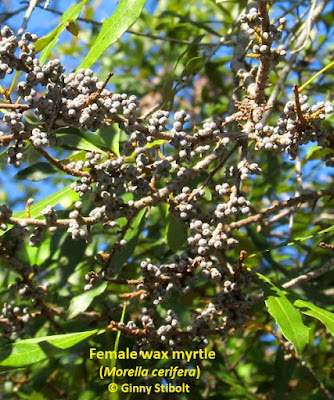
Wax myrtle: an under-used Florida native

The female wax myrtles carry a heavy
load of berries that feed the winter birds.

Wax myrtle (Morella cerifera formerly Myrica cerifera) is an easy-to-grow evergreen shrub or small tree that typically grows to 10-15’ tall and 8-10’ wide, but sometimes it grows to 20’ tall or more. It's native to all of Florida, even The Keys, and naturally occurs in a variety of habitats including edges of wetlands, river margins, sand dunes, pine barrens, hillsides, and upland forests. Species epithet "cerifera" means wax-bearing.

This species is dioecious (male and female flowers borne in catkins on separate plants). Female plants are preferred in the landscape because they produce the fruit to feed the birds, particularly migrating birds during the winter. Of course, at least one male plant is needed in the neighborhood to facilitate pollination of the female flowers.

Sunday, March 28, 2021

Science-based companion planting

Buy your own copy of Plant Partners
by Jessica Walliser
 at Amazon.

Much has been written about which plants work well together, and often the various human emotions, such as love and hate, accompany these descriptions. Extension agents, university professors, and other scientists had debunked most of the anecdotal benefits of traditional companion planting. 

But now there is new science on using various plants to:
- act as trap crops to lure pests away from crops,
- attract predatory insects that will reduce pest problems on crops,
- add diversity, which may confuse pest organisms.
- reduce weeds,
- increase pollinator populations,
- add nutrients, and more.


Jessica Walliser's new book, "Plant  Partners: Science-Based Companion Strategies for the Vegetable Garden" (published by Storey Publishing) is the winner of a 2021 The American Horticultural Society Book Award. Jessica is a rare two-time winner of this prestigious award and her book compiles this latest research on using plants to accomplish several benefits in vegetable gardens. 

Monday, December 21, 2020

Celebrate Winter Solstice 2020

The winter solstice for the Northern Hemisphere occurs on
Monday, December 21, 2020 at 5:02 a.m. EST.

Sunrise over the St. John's River from
Spring Park in Green Cove Springs.

Winter Solstice is the astronomical moment when the Sun reaches the Tropic of Capricorn, which here in the  Northern Hemisphere produces our shortest day and longest night of the year and marks the official start of winter.

At the winter solstice, the sun appears at its southernmost position and at the lowest point in the sky, and its noontime elevation seems to stay the same for several days before and after this day. The sun’s gradual decrease in the sky reverses after the winter solstice and as the hours of daylight become longer, marking what many cultures believe to be a “rebirth” of the Sun.

The term “solstice” is derived from Latin: sol (sun) and sistere (to stand still) because, during the solstice, the sun appears to stand still.

Sunday, November 15, 2020

Lichen: a three-way symbiotic organism

Last week, a neighbor knocked on our door. He was holding a twig covered with lichens. He wanted to know what heck they were and how could he get rid of them, because they were killing his tree. I explained that no, these were not killing his tree, but because the twigs were bare, their spores had germinated there to take advantage of the good light (without the leaves). He's not alone in thinking the the lichens are causing harm to trees, so I thought I should provide some needed background.


Tuesday, July 21, 2020

Winged elm: A beautiful Florida native

The winged elm is so named because of its corky
The winged elm (Ulmus alata) is a graceful medium-sized tree native from Virginia to Texas and to north Central Florida. It grows well in a variety of conditions and should be more widely planted. Gil Nelson describes it as a fast grower in his "Florida's Best Native Landscape Plants." I have to agree with this assessment given my experience with this tree.

In 2010, I was on my first flowered shirt book tour of Florida after the publication of "Sustainable Gardening for Florida." I spoke to a number of the Florida Native Plant Society chapters as part of that tour. At one of those chapters, I was given a winged elm tree that had been auctioned off. The member who won the auction decided that I should have it. Even though the tree was not in good shape, I gracefully accepted his gift and brought it home.

Monday, November 11, 2019

Sequester this carbon! Don't throw it away.

Sequester this carbon! Don't throw it away.
Carbon sequestration is tremendously important because keeping the CO2 levels low in the atmosphere will help keep the earth cooler. It’s the most abundant greenhouse gas.

As I found in doing the research for the Soil section in "Climate-Wise Landscaping," soil sequesters four times more carbon globally than all the terrestrial plants added together, including rainforests. It varies by region and soil type with the peat bogs doing much of the heavy lifting.

Saturday, June 29, 2019

An update: red bay trees that died back from laurel wilt disease in 2008.

Three months before the red bay tree by the
pond turned brown, seemingly overnight,
two pileated woodpeckers gave warning
that bugs were infesting the tree.


Back in 2008, we were shocked when all the red bay trees (Persea borbonia) in our yard suddenly turned totally brown. One day they looked fine, the next day their leaves were all dead. After doing some research, I found that the cause for this was the laurel wilt disease, which was carried by the redbay ambrosia beetle, a tiny insect that entered this country in pallet wood from Asia in Savannah, Georgia in 2004. The beetle carries a fungus that blocks the xylem cells so the water stops flowing through the trees. This is why the symptoms are so sudden, because without the flow of water, the tree cannot function. The fungal disease is known as the laurel wilt disease. Other members of the Laurel family (Lauraeae) that are susceptible to this disease include both natives such as sassafras and spicebush, and non-natives such as avocado and camphortree. Here is a link to the article I wrote back then: Red bay trees are dying.

Thursday, February 14, 2019

Transpiration: Forests' most important service

Through transpiration trees extract huge amounts of water from the soil
and spew it into the atmosphere.

Three Major Cycles in Forests

For a better understanding of the overall value of trees, we'll look at the three major cycles in forests. There are many other processes that also take place, but these three will provide a big-picture look at what's going on in forests, which can then be downsized to fit into our local activities in our yards and in our communities.
1) The Water Cycle:  Water moves through trees, evaporates into the air, forms clouds, rains or snows, both locally and globally. Water from the precipitation is soaked up by trees.
2) The Carbon Cycle:  Carbon absorbed during photosynthesis and is released during respiration, fire & decomposition.
3) The Oxygen Cycle:  O2 is produced through photosynthesis and absorbed through respiration.