Showing posts with label Ecosystem gardening. Show all posts

Tuesday, September 1, 2026

Dioecious vs Monoecious plants & more

Seed-producing plants use sexual reproduction to produce their seeds and are divided into two main groups:
- Angiosperms, the true flowering plants with enclosed ovaries where the seeds are housed in a fruit.
- Gymnosperms, with naked seeds usually housed in cones or cone-like structures.

Seed plant reproductive configurations, but many people combine homoecious (self-fertile or perfect flowers) with monoecious since each plant has both male & female flowers or flower parts.  

There are 3 arrangements or configurations of these sexual organs:
1) Dioecious where the male and female structures are housed on separate plants. The main advantage to this arrangement is that cross pollination is forced, so there is more genetic diversity, which allows the plants with the best characteristics to adapt to a changing environment. The disadvantages are that only half of the plants produce seeds and the spread into to new territories is slowed because both male & female plants must be within breeding range.
2) Monoecious where male and female structures are separate, but on the same plant. The advantage is that the male and female structures are close, but pollination still needs to take place and more cross-pollination may occur. Examples include the squash family (Cucurbitaceae) with separate male & female flowers and some grasses like corn (Zea mays) with their male flowers at the top of the plant and the female flowers tucked into leaf notches that become the ears.
3) Homoecious, hermaphroditic or self-fertile where male and female parts are housed in the same structure. For Angiosperms, this would be a "perfect flower." The advantage is that pollination is much more likely, but one disadvantage is that self-fertilization is likely, which causes less genetic diversity. Some hermaphroditic plants have adapted so they cannot fertilize themselves. The vast majority of angiosperm flowers are perfect. 

Dioecious derives from Greek meaning two houses, and as you can probably guess, monoecious means one house. Homoecious is self or the same house.

Friday, May 1, 2026

Soil: We Need to Stop Treating it Like Dirt

Gardeners can improve their soil.

Why is soil important for gardeners?

We’ve all heard about growing the right plants in the right places so they’ll survive, but without healthy soil, your plants (even the right plants) will suffer or even die. So let’s look at what’s under our feet.

 (This article is an updated version of one I wrote for a garden blog several years ago, which is no longer available online.)


Healthy soil ecosystems are a complex interaction
 between bacteria, fungi, insects, & more.

Soil: the ecosystem beneath our feet

Soil found in native habitats is a complex ecosystem of bacteria, fungi, nematodes, earthworms, ants, salamanders, toads, insect larvae, moles, and more, all living in a substrate of minerals and humus. The minerals are a mixture of rocks, sand, silt, and/or clay. The humus or organic matter consists of fully or partially digested plant and animal parts. As humus is broken down into simple compounds, it provides a living for the decomposers, and eventually yields nutrients for plants. 

One gram (about 1/5 teaspoon) of healthy, non-poisoned soil could contain one hundred million bacteria, one million actinomycetes (a filamentous bacteria), and one hundred thousand fungi; if strung together, their filaments or hyphae would measure about 16 feet (5 meters) in length. This same gram of soil could also contain hundreds of nematodes living on the damp surfaces of the soil particles and maybe a few insect eggs or larvae and some earthworm cocoons. The exact proportions of each of these organisms will depend on soil conditions such as moisture, acidity, aeration, amount of humus, and the local plant community growing in the soil. 

Sunday, February 1, 2026

Alders Fix Nitrogen

Smooth alder or hazel alder (Alnus serrulata)
Photos by Georgia Native Plant Society

Hazel alder or smooth alder (Alnus serrulata) is blooming now with its showy yellow catkins. The woody female flower heads look like little pine cones. It's a tall multi-stemmed shrub to small tree in the birch family (Betulaceae).

This alder is native to freshwater and brackish water wetlands from Texas to Maine and into North Florida. It plays an important role in these wetlands because it fixes nitrogen in its root nodules using Frankia, a genus of anaerobic, filamentous bacteria in the Actinomycetes order. 

When soil is wet all or most of the time it is anaerobic (without air) and in these conditions, the normal soil microbes cannot survive and most plants cannot obtain enough nutrients from this soil. The alders' symbiotic relationship with this weird bacteria provides the nutrients they need to survive and they do so without much competition from other plants.

Saturday, November 1, 2025

This year's roselle crop was amazing!

The roselle was almost as tall as the house.

This year's roselle (Sabdariffa gossypiifolia formerly Hibiscus sabdariffa) crop was amazing even though we were out-of-town for almost 2 months starting at the end of March and again for a month in midsummer. I planned for survival of the roselle shrubs during these trips in a couple of ways. 

- I'd planted them on the back (house-side) of a 10'-long swale and surrounded the area with several wire tomato cages to keep them upright and also to protect them from the deer. 
- The bottom of the swale had been enriched with several loads of kitchen scraps when the roselle shrubs still were small. (Read this article for details on composting in place.) 
- I'd planted tomatoes mostly to one side of the roselle bed, but then strung the sprawling tomato plants onto the front tomato cages. This was also to keep the deer away, because they do not favor tomatoes.
- Before we left on our trip in March, I placed the end of the rain barrel hose into the swale and left the rain barrel on a very slow drip. This way all the water from that downspout was used to irrigate the roselle. 
- Before we left on the second trip, I propped up the plants and tied them together to two 12' poles and to the house. 

Tuesday, July 1, 2025

The importance of Oaks

An oak branch in the white oak group

Oaks

Most oaks (Quercus spp.) are hardwood trees and have been used by people over the ages for building structures and boats. The oak fruit is a true nut with a hard shell and a cap, called the cupule, which protects the kernel. The kernel, which consists of two fatty seed leaves, called cotyledons, which surround a small embryo. This is an important food for wildlife and for early humans once they learned how to remove the bitter tannins.

Oaks are divided into two major groups. The white oaks are those with rounded lobes on their leaves and the acorns mature within one season and are less bitter. The red oaks generally have pointed lobes or sharp lobes on their leaves and their acorns stay on the trees for two seasons, so their acorns have more tannins and are therefore more bitter.

Saturday, May 24, 2025

Sebastião Salgado and his rainforest legacy

Sebastião Ribeiro Salgado Júnior
(8 February 1944 – 23 May 2025)
 

Sebastião Salgado died this week. He was an award-winning Brazilian social documentary photographer and photojournalist. Many of the major news sources have marked his passing by talking about his excellent photography. I wanted to write this to point out what I think is his greatest legacy, the restoration of a rainforest in the Atlantic rainforest area in eastern Brazil, north of Rio de Janeiro and the founding of the non-profit Instituto Terra, which is carrying his rainforest work forward around the world.

Here is what the institute posted on their site:
“Sebastião was much more than one of the greatest photographers of our time. Alongside his life partner, Lélia Deluiz Wanick Salgado, he sowed hope where there was devastation and brought to life the belief that environmental restoration is also a profound act of love for humanity. His lens revealed the world and its contradictions; his life, the power of transformative action.”

Friday, April 4, 2025

Rain gardens in Florida

Stormwater carries pollutants that
end up in our waterways.

Why do we need rain gardens?

Sequestering stormwater reduces pollution of our waterways and of our aquifers. This is because stormwater runoff carries: fertilizers, sediments, plant matter, manures, pesticides, herbicides, salts, oils and other vehicular drippage. 

Pollution that originates from numerous, diffuse sources, such as our yards is called Non-Point-Source (NPS) and the Environmental Protection Agency (EPA) estimates that NPS pollution is the largest threat to our waterways. But, we can reduce NPS pollution from our yards and from our communities by holding or sequestering more rainwater by installing rain barrels and by building rain gardens.

Monday, March 3, 2025

Miami's Underline Park

The Underline is an impressive
& well-used urban park located
under the Metro Rail in Miami.

Taking its inspiration from the High Line Park in New York City and The Lurie Garden in Chicago, The Friends of The Underline non-profit organization formed in 2013. The Underline is basically a multi-use path with parks, recreational spaces, playgrounds, plantings, and stormwater infrastructure. It's expected to extend to its full 10-mile distance by 2026.

These gardens feature untrimmed native plants that attract and feed insects and birds. This is different than traditional formal gardens where everything is tightly trimmed and exotic plants are chosen for their beauty and because they are not favored by the local insects. This style is left over from British and European upper class expectations where those who owned grand houses and estates favored those highly maintained gardens to show how wealthy they were.

Sunday, December 1, 2024

It's Time to Think Globally, but Act Locally.

www.climatewiselandscaping.com 

Climate change is real!

We are seeing its effects on the weather with more frequent, stronger and slower-moving hurricanes, more severe droughts, more fires, and rising sea levels. But Sue Reed and I did not debate the reality of climate change or what has caused these rapid changes when we wrote our award-winning book, "Climate-Wise Landscaping: Practical Actions for a Sustainable Future." Instead we said, "Let's roll up our sleeves and get to work."

The same thing has happened in the writing of my 7th book with the working title "Living Shorelines for Florida: A Practical Guide for Building Resilience," which will be published in 2025. I and my three coauthors did not debate sea level rise or discuss what the causes might be, but plans for dealing with rising sea levels are included in our various actions and designs for more resilient shorelines.

So what actions can we take and will it make any difference?

While actions we take in our yards and in our communities may seem insignificant, there are many millions of homeowners and communities, and together, we are a powerful force. What follows are some ideas and links to resources for some of the most significant actions. 

Thursday, August 1, 2024

Snags, stumps, and logs provide habitat

Three birds perched on a snag. A ball moss
(Tillandsia recurvata) also lives on this snag.

Dead standing trees are snags. If a snag is located so that it will not hurt people or damage property, leave it standing for its wildlife value. Snags are highly productive sources of habitat that work well in both natural areas and designed landscapes.

Tree basics

The vast majority of organisms on our planet depend upon the life-giving process of photosynthesis. Plants and other organisms with chlorophyll combine carbon dioxide from the air and water with energy from the sun to form sugars and oxygen gas. The plant can then combine the sugars to form starches, fats, enzymes, or whatever the plant needs. 

Photosynthesis: 6CO2 + 6H2O >> C6H12O6 + 6O2

Then most living organisms (plants, animals, fungi, bacteria) take in oxygen and digest the sugars in one form or another to gain energy for life through respiration, a process the equal and opposite of photosynthesis. 

Respiration: C6H12O6 + 6O2  >> 6CO2 + 6H2O 

Since trees normally live for many years, they sequester carbon in their wood and root tissues as long as they live, while the flowers, fruits and leaves store carbon only temporarily until they are eaten or decompose. Much of this decomposing plant matter ends up in the soil. But when a tree dies, the wood begins to break down as bacteria, fungi, insects, and other organisms begin to absorb the wood tissue so they can gain energy for life. As the wood deteriorates, then birds and other larger animals can consume the decomposers and so the carbon-based sugars stored in the wood moves up the food chain. The organisms store the sugars created during photosynthesis, but as they respire and when they die, the carbon is released into the atmosphere.

One note here on carbon sequestration: The soil sequesters 3 to 4 times as much carbon as all the terrestrial plants, including rain forests. Peat is especially important since it can sequester carbon for thousands of years. This is important because the more carbon sequestered means less carbon dioxide, our most abundant greenhouse gas, in the atmosphere and that is good for our only planet. (Read my article on peat moss.)

Monday, July 1, 2024

Winged sumac, a useful understory shrub

A small winged sumac in bloom, which
attracts a wide variety of pollinators.

Winged Sumac (Rhus copallinum) is a deciduous, compact, densely growing, colonizing shrub that is native to all of Florida and the eastern half of North America. It can grow to 10 to 25 feet tall and nearly as wide, although the ones in our yard are much smaller than that. They will grow in a wide variety of situations, but they do best in full sun or partial shade and require good drainage. 

This plant could be used in a hedge row with a variety of other shrubs and is a good choice for naturalizing at the edge between wooded and open areas. Keep in mind that it will be bare for a few months in the winter. It can spread quite some distance via rhizomes or underground roots, so keep that in mind when choosing planting sites.

Saturday, June 1, 2024

Shrubs in the landscape

A newly renovated house in our neighborhood with its
newly-installed curb-appeal shrubs where there were none.

Shrubs as the default foundation plantings

Shrubs are easy for the builders to install and they give the landscape a "finished" and the expected look for a house.

Here's a house in our neighborhood that recently went on the market after extensive interior renovations according to its online listing. But what bothered me was that they removed two mature trees on the west side of the house, which cooled the area especially in the afternoon, removed the awnings on the windows, and then installed a row of useless, sprawling shrubs along the foundation. One of the trees may have been too close to the house, but the other one was fine. 

This was in 2022 when their azaleas were blooming. I was not
focused on the house, but the thickets.

I had taken a photo of this house in 2022 when their Japanese azaleas (Rhododendron japonicum), which are planted around some trees, were in bloom to include in my article, Habitat Gardening. The tree in the foreground is an old redcedar (Juniperus virginiana) next to the road, which is still there.

So the real problem with foundation shrubs is that they usually outgrow their spaces, some sooner than others. Sometimes it's just that they grow too tall, but other shrubs with aggressive spreading roots could also damage the building's foundation. 

Wednesday, May 1, 2024

Composting in place: Part 2

I scored a huge load of wood chips the
other day--mostly pines (with needles)
& oaks. This close to our 30th
load since 2004.

I wrote "Enrich soil for crops by composting in-place" back in 2019 about how I build soil and our raised beds for growing our vegetables, which includes the whole process from building the beds (without hard sides) to trench composting to add additional organic materials to the soil. While no gardener can claim 100% success rate in growing veggies, over all I've been quite successful over the years with these wide-row beds. Plus, this article has been one of the most visited.

This article is a follow-up to that piece and it's also centered around our vegetable beds, but this time I cover what's between the beds and how beautifully rich soil is also created there.

A new arborist chip dump

On our morning walk, I saw a tree company getting ready to work a couple of streets over from ours. I walked back over there and asked for their load of chips, they were happy to do so. They were just getting ready to drive their truck to the dump, as I walked the 1/2 mile back home, the truck passed me and I explained where to dump them, but the driver already knew where to go because he'd dumped loads there before. 

Monday, April 1, 2024

White Wild Indigo

It planted itself in a location that's too close to
 the sidewalk, but I'll leave it there since they
don't transplant well.

White Wild Indigo: A beautiful perennial pollinator plant

White wild indigo (Baptisia alba) is a plant worth including in your pollinator garden. It is pollinated by large bees including bumblebees and carpenter bees. It's also a host plant for Wild indigo duskywing and Zarucco duskywing butterflies. The fruits are eaten by birds. While it's an important plant in the local ecosystem, it's toxic to humans and livestock.

It is best propagated from scarified seed. Once established, plants should not be moved, since they have a long tap root. They take several years to reach maturity but are long-lived, and often grows 2-3 feet tall, frequently wider than it is tall. It produces showy white flowers March-May, but is dormant in winter. Use it as a small shrub or background plant in a border located in full sun to partial shade. 

It is a tri-foliate legume and can thrive in a variety of poor soils including acidic to neutral clay, loam, or sand. It naturally occurs in a sandhill environment, so established plants can tolerate some drought, but never flooding. 

Monday, January 1, 2024

Ohio Spiderwort: a pollinator-friendly native wildflower

A small fly-like bee was pollinating this flower.

Bluejacket or Ohio spiderwort (Tradescantia ohiensis) is native to most of Eastern North America and to most of Florida. It attracts pollinators, especially bees. Each day, one or two flowers bloom in each flower head. They open early in the morning and then wilt in the afternoon. Each flower head contains twenty or more flowers and new flower heads are formed throughout the long season from early spring to late fall. There is a long blooming season.

There are three other species of spiderworts native to Florida: hairy spiderwort (T. hirsutiflora), longleaf spiderwort (T. roseolens), and zigzag spiderwort (T. subaspera). But the bluejacket has the largest native range and is the one that's most readily available from the native trade.

Spiderworts are monocots and are in the Commelina family (Commelinaceae), which includes 36 genera world wide, but only five occur in Florida. "Spiderwort" refers to the sap which dries into web-like threads when a stem is cut.

Thursday, November 2, 2023

Florida's goldenrods

Goldenrods do Not cause allergies

The insect-pollinated goldenrods (Solidago spp.) with their beautiful flowers have erroneously been blamed for fall allergy season when it's the wind-pollinated ragweed (Ambrosia spp.) with the unnoticeable green flowers that are filling the air with pollen when the goldenrods are blooming. The ragweeds do not need to put any energy into creating beautiful flowers or sweet nectar because the wind will blow anyway. As I understand it, some allergy doctors test people to see if they are allergic to goldenrod pollen even though that pollen is too heavy and sticky to float in the air and there is zero chance of its getting into anyone's nose. 

A swallowtail butterfly is pale in comparison to
the very yellow goldenrod.
Ragweed, the source of the air-borne pollen that gives people hay fever.

Sunday, October 1, 2023

Why talking about native plant landscapes is so important

Consumers are presented with this array of mostly
nonnative plants in full bloom to plant so their yards can
decorated with plants at peak bloom all the time.

Where are the native plants?

New homeowners and beginning gardeners find displays similar to this photo that I took at a big box store a few years ago. It's filled with mostly nonnative annuals in full bloom. Each tray is not too expensive, but after they fade in a couple of months, people are expected to come back to replace them with the next set. 

Examples in garden magazines and gardening TV shows with their instant landscapes imply that garden installations are events, and not ongoing projects that develop over the years.

Tuesday, August 1, 2023

Starry rosinweed is a star in Florida yards

Starry rosinweed is a star in your garden not only
for its beauty and long blooming cycle, but also because
of the wide variety of pollinators that it attracts.

Starry Rosinweed (Silphium asteriscus) is a member of the aster or daisy family, Asteraceae and is a wonderful choice for Florida's wildflower meadows and for pollinator gardens. It's a beautiful, tall, long-lived, drought tolerant, easy-to-care-for wildflower. (See below for more information on how it behaves in gardens and meadows.)

Botanically, the starry rosinweed is an outlier in the aster family. Yes, its flower head has the typical arrangement of disk florets in the center surrounded by showy ray florets that each have one outsized petal. 

In most aster family plants with this typical flower head arrangement such as sunflowers, only the tiny, cylindrical disk florets in the center produce fruits or seeds, while the petal-like ray florets around the outside of the center are sterile and produce no fruits. The starry rosinweed is exactly the opposite with its ray florets producing fruits and the disk florets being sterile.

Monday, May 1, 2023

Hibiscus: Plants with the most beautiful flowers

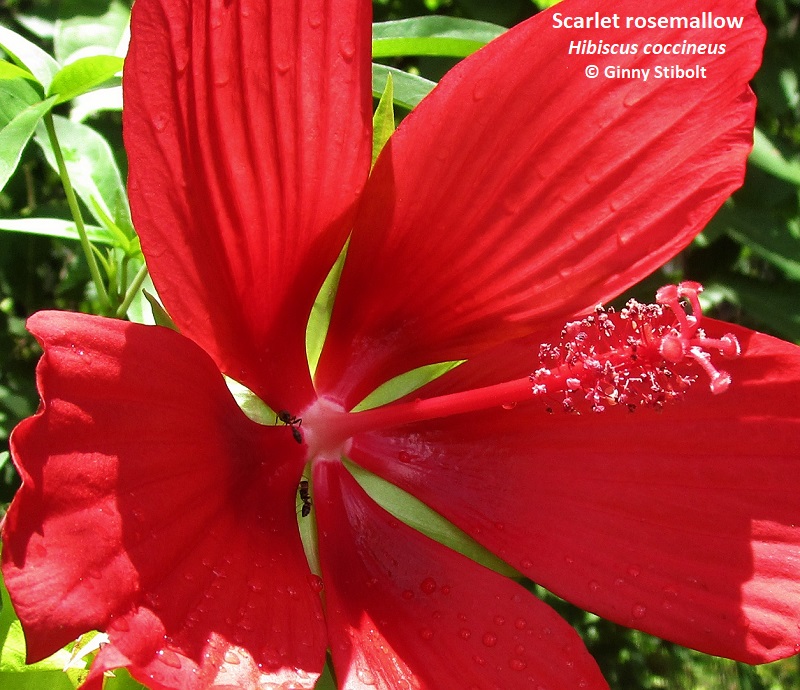
A scarlet rosemallow (Muenchhusia coccineus):
 a Florida native

There are 432 Hibiscus species that are found worldwide, and with their beautiful flowers, many are grown in gardens and some are even used as crops. In general, the flowers are large and showy. (Updatre in June 2026: Some of Florida's native Hibiscus species are now Muenchhus, while some others are Sabdariffa.)

For example, see the scarlet rosemallow in the lead photo. Here there are five green sepals subtending five large red petals. The pistil, the female reproductive part of a plant, is attached to the center of the flower. The pistil is made up of a five-chambered ovary where seeds develop, the style that is a long tube between the ovary and five round stigmas where the pollen is absorbed. A stamen, the male reproductive structure, consists of the anther that holds the pollen, and a stalk called the filament. In hibiscus flowers, the filaments fuse into a tube that surrounds the style. Numerous anthers stick out from the filaments below the five stigmas at the top of the style. The prominent pistil with all those anthers is one reason the hibiscus flowers are so showy.

Saturday, April 1, 2023

Netted chain ferns

Netted chain fern: sterile fronds.

The netted chain fern (Woodwardia areolata) is native to eastern North America including most of Florida. It spreads via rhizomes and acts as a ground cover in partially shaded areas with some moisture. 

Leaves or fronds are dimorphic with the sterile leaves being flat and relatively broad for a fern, while the fertile fronds (those bearing the spores in structures called sori. (Sorus is the singular.)) are taller and have very little green leafy area. For this fern, sori are oblong and are arranged in neat lines, this is the characteristic that gives the chain ferns their name. In North Florida and in more northerly areas in its range, the green sterile fronds die back in the winter, while the fertile fronds persist through the winter.