Showing posts with label Sustainability. Show all posts

Sunday, February 1, 2026

Alders Fix Nitrogen

Smooth alder or hazel alder (Alnus serrulata)
Photos by Georgia Native Plant Society

Hazel alder or smooth alder (Alnus serrulata) is blooming now with its showy yellow catkins. The woody female flower heads look like little pine cones. It's a tall multi-stemmed shrub to small tree in the birch family (Betulaceae).

This alder is native to freshwater and brackish water wetlands from Texas to Maine and into North Florida. It plays an important role in these wetlands because it fixes nitrogen in its root nodules using Frankia, a genus of anaerobic, filamentous bacteria in the Actinomycetes order. 

When soil is wet all or most of the time it is anaerobic (without air) and in these conditions, the normal soil microbes cannot survive and most plants cannot obtain enough nutrients from this soil. The alders' symbiotic relationship with this weird bacteria provides the nutrients they need to survive and they do so without much competition from other plants.

Wednesday, October 1, 2025

Food-from-scraps

I prepare a whole row for come-again crops.
So far this year I have two starts: celery &
romaine lettuce.

Instead of throwing away or composting the bases of store-bought celery, cabbages, leaf lettuces, and other cool-weather crops, you can grow new food. The base must include a root-bearing zone. This is a fun project for kids, because you see results in just a few days.

As, I prepare wide rows for my fall and winter crops, I also prepare a food-from-scraps row. It's usually a fairly narrow row about a foot wide. First, I bury kitchen scraps and compost down the middle of the row and leave a shallow swale on the surface so that water stays in place and soaks into the soil. Then I mulch the row with pine needles. Here's link to my wide-row article for more detail & photos.

So far this year, I have two starts in this row, celery and romaine lettuce. Over the years, I have had the best success with celery, so much so, that I never plant it as a crop from seeds or plants. Cabbage has also been quite reliable and I end up harvesting the come-again cabbage leaves well before my regular cabbage crops mature.

Monday, March 3, 2025

Miami's Underline Park

The Underline is an impressive
& well-used urban park located
under the Metro Rail in Miami.

Taking its inspiration from the High Line Park in New York City and The Lurie Garden in Chicago, The Friends of The Underline non-profit organization formed in 2013. The Underline is basically a multi-use path with parks, recreational spaces, playgrounds, plantings, and stormwater infrastructure. It's expected to extend to its full 10-mile distance by 2026.

These gardens feature untrimmed native plants that attract and feed insects and birds. This is different than traditional formal gardens where everything is tightly trimmed and exotic plants are chosen for their beauty and because they are not favored by the local insects. This style is left over from British and European upper class expectations where those who owned grand houses and estates favored those highly maintained gardens to show how wealthy they were.

Sunday, September 1, 2024

Grapes (Vitis spp.)

A muscadine grape (Vitis rotundifolia 'Alachua')
Credit: Ali Sarkhosh, UF/IFAS

Florida's grapes

There are six species of grapes that are native to Florida, while some have small ranges, grapes are found in all parts of the state. 

- Summer grape (Vitis aestivalis)
- Florida grape (Vitis cinerea var. floridana)
- Catbird grape (Vitis palmata)
- Muscadine (Vitis rotundifolia)
- Calloose grape (Vitis shuttleworthii)
- Frost grape (Vitis vulpina)

The muscadine grape is native to all of Florida and from Delaware to eastern Texas. This is grown as a sustainable crop in Florida and has been bred so that this normally dioecious plant (with separate male and female plants) is self-fertile or monoecious.

Thursday, August 1, 2024

Snags, stumps, and logs provide habitat

Three birds perched on a snag. A ball moss
(Tillandsia recurvata) also lives on this snag.

Dead standing trees are snags. If a snag is located so that it will not hurt people or damage property, leave it standing for its wildlife value. Snags are highly productive sources of habitat that work well in both natural areas and designed landscapes.

Tree basics

The vast majority of organisms on our planet depend upon the life-giving process of photosynthesis. Plants and other organisms with chlorophyll combine carbon dioxide from the air and water with energy from the sun to form sugars and oxygen gas. The plant can then combine the sugars to form starches, fats, enzymes, or whatever the plant needs. 

Photosynthesis: 6CO2 + 6H2O >> C6H12O6 + 6O2

Then most living organisms (plants, animals, fungi, bacteria) take in oxygen and digest the sugars in one form or another to gain energy for life through respiration, a process the equal and opposite of photosynthesis. 

Respiration: C6H12O6 + 6O2  >> 6CO2 + 6H2O 

Since trees normally live for many years, they sequester carbon in their wood and root tissues as long as they live, while the flowers, fruits and leaves store carbon only temporarily until they are eaten or decompose. Much of this decomposing plant matter ends up in the soil. But when a tree dies, the wood begins to break down as bacteria, fungi, insects, and other organisms begin to absorb the wood tissue so they can gain energy for life. As the wood deteriorates, then birds and other larger animals can consume the decomposers and so the carbon-based sugars stored in the wood moves up the food chain. The organisms store the sugars created during photosynthesis, but as they respire and when they die, the carbon is released into the atmosphere.

One note here on carbon sequestration: The soil sequesters 3 to 4 times as much carbon as all the terrestrial plants, including rain forests. Peat is especially important since it can sequester carbon for thousands of years. This is important because the more carbon sequestered means less carbon dioxide, our most abundant greenhouse gas, in the atmosphere and that is good for our only planet. (Read my article on peat moss.)

Monday, July 1, 2024

Winged sumac, a useful understory shrub

A small winged sumac in bloom, which
attracts a wide variety of pollinators.

Winged Sumac (Rhus copallinum) is a deciduous, compact, densely growing, colonizing shrub that is native to all of Florida and the eastern half of North America. It can grow to 10 to 25 feet tall and nearly as wide, although the ones in our yard are much smaller than that. They will grow in a wide variety of situations, but they do best in full sun or partial shade and require good drainage. 

This plant could be used in a hedge row with a variety of other shrubs and is a good choice for naturalizing at the edge between wooded and open areas. Keep in mind that it will be bare for a few months in the winter. It can spread quite some distance via rhizomes or underground roots, so keep that in mind when choosing planting sites.

Saturday, June 1, 2024

Shrubs in the landscape

A newly renovated house in our neighborhood with its
newly-installed curb-appeal shrubs where there were none.

Shrubs as the default foundation plantings

Shrubs are easy for the builders to install and they give the landscape a "finished" and the expected look for a house.

Here's a house in our neighborhood that recently went on the market after extensive interior renovations according to its online listing. But what bothered me was that they removed two mature trees on the west side of the house, which cooled the area especially in the afternoon, removed the awnings on the windows, and then installed a row of useless, sprawling shrubs along the foundation. One of the trees may have been too close to the house, but the other one was fine. 

This was in 2022 when their azaleas were blooming. I was not
focused on the house, but the thickets.

I had taken a photo of this house in 2022 when their Japanese azaleas (Rhododendron japonicum), which are planted around some trees, were in bloom to include in my article, Habitat Gardening. The tree in the foreground is an old redcedar (Juniperus virginiana) next to the road, which is still there.

So the real problem with foundation shrubs is that they usually outgrow their spaces, some sooner than others. Sometimes it's just that they grow too tall, but other shrubs with aggressive spreading roots could also damage the building's foundation. 

Friday, March 1, 2024

Carrots: a most satisfying cool-weather crop

Carrots are native to Europe and parts of Asia and
Africa, but now have escaped around the world and
those wild carrots are known as Queen Anne's lace.

Carrots (Daucus carota) are in the carrot family Apiaceae. While this plant family includes quite a few well-known and economically important crop plants as anise, caraway, carrot, celery, chervil, coriander, cumin, dill, fennel, parsley, and parsnip, there are also a few highly poisonous species, such as poison hemlock, water hemlock, spotted cowbane, and fool's parsley. 

The defining characteristic of this family is the inflorescence, the flowers nearly always aggregated in terminal umbels, that may be simple or more commonly compound. The other name for this family is Umbelliferae. 

Thursday, November 2, 2023

Florida's goldenrods

Goldenrods do Not cause allergies

The insect-pollinated goldenrods (Solidago spp.) with their beautiful flowers have erroneously been blamed for fall allergy season when it's the wind-pollinated ragweed (Ambrosia spp.) with the unnoticeable green flowers that are filling the air with pollen when the goldenrods are blooming. The ragweeds do not need to put any energy into creating beautiful flowers or sweet nectar because the wind will blow anyway. As I understand it, some allergy doctors test people to see if they are allergic to goldenrod pollen even though that pollen is too heavy and sticky to float in the air and there is zero chance of its getting into anyone's nose. 

A swallowtail butterfly is pale in comparison to
the very yellow goldenrod.
Ragweed, the source of the air-borne pollen that gives people hay fever.

Tuesday, August 1, 2023

Starry rosinweed is a star in Florida yards

Starry rosinweed is a star in your garden not only
for its beauty and long blooming cycle, but also because
of the wide variety of pollinators that it attracts.

Starry Rosinweed (Silphium asteriscus) is a member of the aster or daisy family, Asteraceae and is a wonderful choice for Florida's wildflower meadows and for pollinator gardens. It's a beautiful, tall, long-lived, drought tolerant, easy-to-care-for wildflower. (See below for more information on how it behaves in gardens and meadows.)

Botanically, the starry rosinweed is an outlier in the aster family. Yes, its flower head has the typical arrangement of disk florets in the center surrounded by showy ray florets that each have one outsized petal. 

In most aster family plants with this typical flower head arrangement such as sunflowers, only the tiny, cylindrical disk florets in the center produce fruits or seeds, while the petal-like ray florets around the outside of the center are sterile and produce no fruits. The starry rosinweed is exactly the opposite with its ray florets producing fruits and the disk florets being sterile.

Monday, May 1, 2023

Hibiscus: Plants with the most beautiful flowers

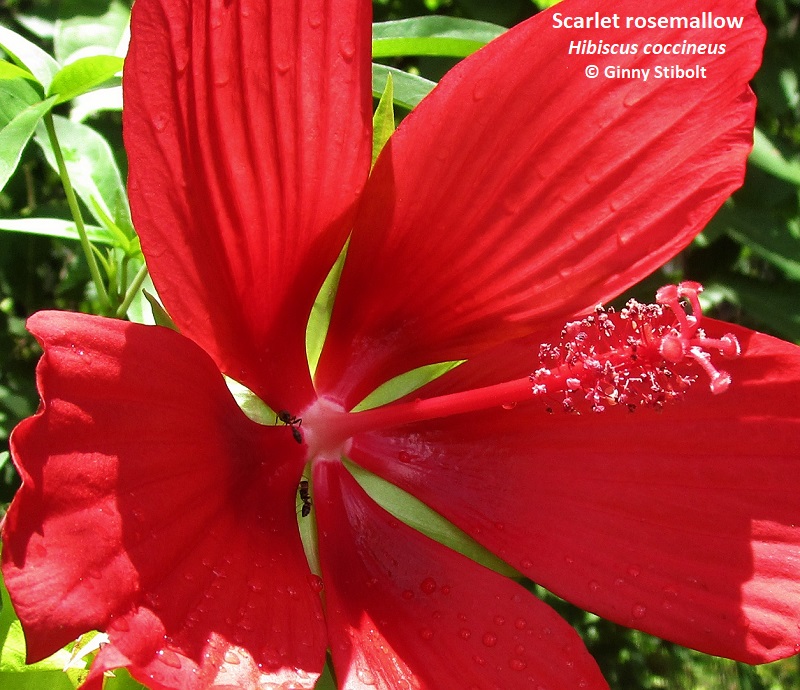
A scarlet rosemallow (Muenchhusia coccineus):
 a Florida native

There are 432 Hibiscus species that are found worldwide, and with their beautiful flowers, many are grown in gardens and some are even used as crops. In general, the flowers are large and showy. (Updatre in June 2026: Some of Florida's native Hibiscus species are now Muenchhus, while some others are Sabdariffa.)

For example, see the scarlet rosemallow in the lead photo. Here there are five green sepals subtending five large red petals. The pistil, the female reproductive part of a plant, is attached to the center of the flower. The pistil is made up of a five-chambered ovary where seeds develop, the style that is a long tube between the ovary and five round stigmas where the pollen is absorbed. A stamen, the male reproductive structure, consists of the anther that holds the pollen, and a stalk called the filament. In hibiscus flowers, the filaments fuse into a tube that surrounds the style. Numerous anthers stick out from the filaments below the five stigmas at the top of the style. The prominent pistil with all those anthers is one reason the hibiscus flowers are so showy.

Saturday, April 1, 2023

Netted chain ferns

Netted chain fern: sterile fronds.

The netted chain fern (Woodwardia areolata) is native to eastern North America including most of Florida. It spreads via rhizomes and acts as a ground cover in partially shaded areas with some moisture. 

Leaves or fronds are dimorphic with the sterile leaves being flat and relatively broad for a fern, while the fertile fronds (those bearing the spores in structures called sori. (Sorus is the singular.)) are taller and have very little green leafy area. For this fern, sori are oblong and are arranged in neat lines, this is the characteristic that gives the chain ferns their name. In North Florida and in more northerly areas in its range, the green sterile fronds die back in the winter, while the fertile fronds persist through the winter.

Sunday, January 1, 2023

Red cedar: an important habitat tree

A female red cedar with fruit.

Red cedar (Juniperus virginiana) is medium-sized, dioecious evergreen conifer with female trees that bear waxy, berry-like cones, which many types of birds will eat as the weather grows colder.

While most botanists agree that there is one species of red cedar that's native to most of eastern North America, the old precedent recognized coastal red cedar (J. silicicola) and eastern red cedar (J. virginiana) a bit inland, with a big range from Texas to southern Ontario. This old protocol meant that except for the northern border of Florida's Panhandle, the red cedars native to Florida were the coastal species.

Red cedar is in the cypress family (Cupressaceae), which has world-wide distribution--except for Antarctica. Other members of this family found in Florida are two cypresses: pond cypress (Taxodium ascendens) and bald cypress (T. distichum); Atlantic white cedar (Chamaecyparis thyoides); plus the non-natives: oriental arborvitae (Platycladus orientalis) and white cypress-pine (Callitris glaucophylla).

Thursday, December 1, 2022

Fall cucumbers

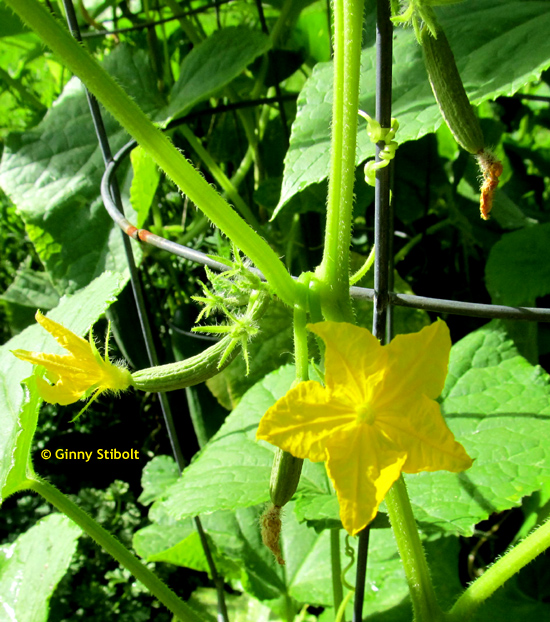
Cucumber (Cucumis sativus) is in the squash family (Cucurbitaceae) and is more closely related to melons than the squashes, which are in the Cucurbita genus. It's native to India but has been under cultivation as a crop for about 3,000 years. Now, it is widely cultivated around the world.

Male and female cucumber flowers. The female flower sits atop a small, preformed fruit. If the flower is not adequately pollinated, then the fruit will not expand, turn yellow, and fall off the vine.

Tuesday, October 4, 2022

Habitat gardening

In natural areas, the soil ecosystem supports the plants,
which support the insects, which in turn support
the birds and other wildlife.

Florida's default landscapes

Most yards in Florida consist of highly maintained monoculture lawns, a few stand-alone trees, and a fringe of foundation plants around the buildings. This is the opposite of habitat gardening because typical Florida lawn care includes regular landscape-wide applications of insecticides, herbicides, fungicides and other poisons. Then since these pesticides are not good for the turfgrass, synthetic fertilizer is applied to keep it green.

This treatment damages the soil ecosystem (shown in the poster here), which plays an important role in keeping the plants healthy, which then support the insects and the birds. In addition, much of the lawn chemicals have rinsed through the soil or have been carried away with erosion to pollute our waterways causing too much algae growth and toxic dead zones.

Wednesday, June 1, 2022

Growing onions and garlic in North Florida


Onion planting day: November 26

Onions and garlics

Both onions and garlics are in the genus Allium, which contains several crops that are divided into two groups:
1) Onions, which have hollow leaves and 
2) Garlics, which have flat, solid leaves. (*See note below on the family.)

Onions (Allium cepa) are treated as a long-season annual in Florida. Botanically, they are biennials, where in a natural habitat, they would grow leaves and form a bulb the first year, go into dormancy, and the second year they would use the stored energy in the bulb to form flowers, which are borne on a specialized stem called a scape. We interrupt this cycle by harvesting as the plant goes dormant and when the bulb is at its maximum size. 

Friday, April 22, 2022

The value of trees

 An appreciation of trees

Trees in our yards and in our communities add to the global
population, which is crucial for slowing down climate change.

Here are just some of the many ways that trees are important not only in our urban and suburban neighborhoods, but also for the whole planet:

- Trees actually cool the air through transpiration. A mature deciduous tree like an oak will transpire more than 400 liters of water on a hot summer's day. In the process of liquid water evaporating (going from liquid to gas) the air is cooled. At 68˚F each gram of water that evaporates, cools the air by 585 calories. Transpiration: Forests' most important service

- Trees sequester carbon, by absorbing carbon dioxide (CO2) a long-lasting greenhouse gas, through the process of photosynthesis where they remove carbon dioxide from the air to make sugars, which are then stored in the various plant tissues. A typical hardwood tree can absorb as much as 48 pounds of carbon per year. This means it will sequester approximately 1 ton of carbon by the time it reaches 40 years old. Carbon sequestration

- Trees produce oxygen through photosynthesis, but trees and all the other organisms in the forest absorb most of that oxygen to live. Also read Transpiration: Forests' most important service where I talk about three cycles in the forest: Carbon, Oxygen, and Water.

- Trees remove carbon monoxide (CO) and other air pollutants from the air. They are absorbed primarily through stomata (pores) on the leaves where they diffuse into intercellular spaces and may be absorbed by water films to form acids or react with inner-leaf surfaces. Trees can remove significant amounts of air pollution in cities, where it is often concentrated. More information on this from the EPA.

Friday, October 1, 2021

Removing invasive plants costs Florida $45 million per year

Mimosa tree (Albizia julibrissin),
a Category I invasive in all of Florida.

Yet, many of these plants are still for sale

How did we get into this situation?

A few hundred years ago, once world travel was readily available, many plants and animals were transported from their native habitats where natural checks and balances evolved over millennia so that predator & food sources were in balance. (I will be talking about plants in this post, but invasive animal species are also a huge problem in Florida.) 

People moved thousands of plant species for a number of reasons:
- to bring food crops with them as they settled into new places.
- they collected beautiful plants from around the world to plant in gardens as a novelty or for prestige.
- Some plants were imported for their utility such as stopping erosion (such as kudzu (Pueraria montana)) or building fast-growing hedges (such as, Brazilian pepper (Schinus terebinthifolia)).
- Many non-native plants have been favored in the landscaping industry because most local insects and other critters do not feed on them, so they are easier to grow and sell, because they "look good."
and...
- Sometimes the plants were introduced to new regions by accident as hitchhikers with other plants or with other products that were being transported.

What is "invasive" and how is that status determined?

Saturday, May 1, 2021

Our freedom lawn


We let our lawn go wild!

When we first moved into our house, the lawn-care guys who had worked for the former owner stopped by to offer to continue their services. When I refused, they said that without their poisons (fungicides, insecticides, and herbicides) and their specially-formulated fertilizer and weed & feed applications that our lawn would die. Well, as it turns out, a few months later some brown spots did develop, but they were soon taken over by other plants, which those lawn guys would probably have condemned as "weeds."

Monday, October 12, 2020

An unexpected drainage project

A complex location, with a raised sprinkler head, a newly
reinstalled downspout, and the access to the septic system.

Rain barrels on the move

We moved the three rain barrels that we'd installed at the back of the garage. Initially, years ago, they were elevated on a wooden platform, but when the wood gave out due to stress from all that weight, we reinstalled them in the same place on separate cinderblock towers. I wrote about them here: Three more rain barrels and here: Reworking the elevated rain barrels.

Well, since there was no cross bracing between the towers, the cinderblocks tipped and sank into the soil at different rates. This caused a problem with the plumbing since the barrels are connected together to have one spigot. 

My husband disassembled barrels and reinstalled the downspout for this end of the gutter that runs along two sides of the garage. The other end feeds into two different rain barrels. 

The three barrels sat unused through the summer, but the dry season was coming and I'd be growing a large selection of cool-weather crops and I'd need the capacity of those three barrels. In looking at this location we could not install a concrete pad to provide more stability because the main septic pipe from the house runs through the area. We decided to move barrels to the north side of the garage where there was already a concrete pad and to move the ten-foot gutter to gather the water.