Tuesday, March 1, 2022

Red maples in Florida

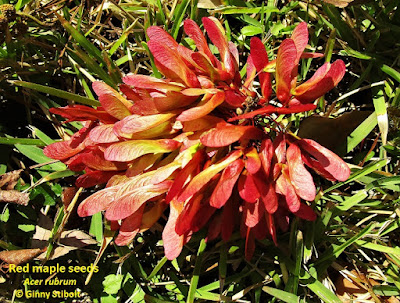
A large clump of maple seeds. It readily reseeds.

Red maples are versatile trees

The red maple (Acer rubrum) is native to most of Florida and its range also includes almost all of eastern North America including Canada. According to the U.S. Forest Service, it's one of the most abundant trees in this range, because it grows well in a wide variety of habitats and because it's easy to grow and has reliable fall color even in Florida, it is widely planted. It will grow in both wet and dry soil, but in the southern part of Florida it's mostly found in wet soils. While it prefers some acidity, it tolerates a variety of soil types.

Tuesday, February 1, 2022

Salad burnet: an easy-to-grow perennial crop

Salad burnet (Sanguisorba minor) is a perennial crop in the rose family (Rosaceae) that is native to all of Europe, northern Africa and also in southern Africa. It's easy to grow from seed and it reseeds. It's best to plant this with other perennial crops and herbs so it does not get in the way during crop rotations.

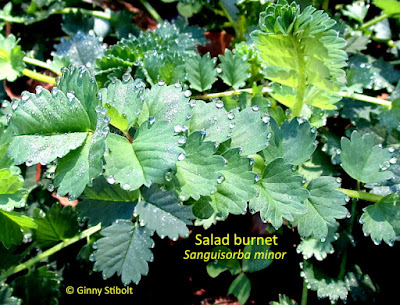
Salad burnet leaves in the morning with guttation* drops on
the ends of all the leaf serrations.

Sunday, January 2, 2022

Wax myrtle: an under-used Florida native

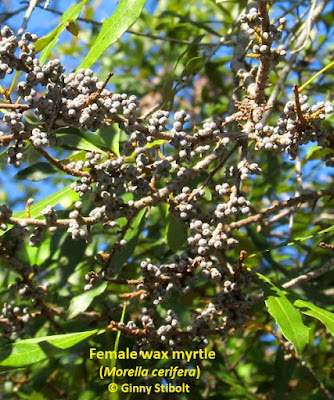
The female wax myrtles carry a heavy
load of berries that feed the winter birds.

Wax myrtle (Morella cerifera formerly Myrica cerifera) is an easy-to-grow evergreen shrub or small tree that typically grows to 10-15’ tall and 8-10’ wide, but sometimes it grows to 20’ tall or more. It's native to all of Florida, even The Keys, and naturally occurs in a variety of habitats including edges of wetlands, river margins, sand dunes, pine barrens, hillsides, and upland forests. Species epithet "cerifera" means wax-bearing.

This species is dioecious (male and female flowers borne in catkins on separate plants). Female plants are preferred in the landscape because they produce the fruit to feed the birds, particularly migrating birds during the winter. Of course, at least one male plant is needed in the neighborhood to facilitate pollination of the female flowers.

Wednesday, December 1, 2021

Tropical sage: a Florida native wildflower

A tattered gulf fritillary (Agraulis vanillae)
feeding on a tropical sage.

Tropical sage (Salvia coccinea) is a beautiful, easy-to-grow Florida native wildflower in the mint family, Lamiaceae. It has a long blooming cycle and its flowers are usually scarlet red, but sometimes are pink, even in natural areas. In addition to attracting hummingbirds, butterflies and native bees, tropical sage is the larval host for several sphynx moths. 

It's considered to be an annual, but I've had many that have lasted for two seasons and it's a prolific reseeder. So this plant is a wonderful addition to your pollinator gardens and wildflower meadows.

Monday, November 1, 2021

Roselle: Florida's cranberry

Roselle (Sabdariffa gossypiifolia formerly Hibiscus sabdariffa)

The calyces subtend and support the petals. The flower lasts for only one day and when the petals fall off, the sepals begin to swell to surround the developing fruit. 

The five overlapping petals of the roselle flower are pale yellow tinged with burgundy on the edges and becoming deep burgundy in the center of the flower where the pistil emerges.

The mallow family: Malvaceae

Friday, October 1, 2021

Removing invasive plants costs Florida $45 million per year

Mimosa tree (Albizia julibrissin),
a Category I invasive in all of Florida.

Yet, many of these plants are still for sale

How did we get into this situation?

A few hundred years ago, once world travel was readily available, many plants and animals were transported from their native habitats where natural checks and balances evolved over millennia so that predator & food sources were in balance. (I will be talking about plants in this post, but invasive animal species are also a huge problem in Florida.) 

People moved thousands of plant species for a number of reasons:
- to bring food crops with them as they settled into new places.
- they collected beautiful plants from around the world to plant in gardens as a novelty or for prestige.
- Some plants were imported for their utility such as stopping erosion (such as kudzu (Pueraria montana)) or building fast-growing hedges (such as, Brazilian pepper (Schinus terebinthifolia)).
- Many non-native plants have been favored in the landscaping industry because most local insects and other critters do not feed on them, so they are easier to grow and sell, because they "look good."
and...
- Sometimes the plants were introduced to new regions by accident as hitchhikers with other plants or with other products that were being transported.

What is "invasive" and how is that status determined?

Saturday, September 4, 2021

Wild sweet basil

Wild sweet basil has lavender flowers
unlike sweet basil and lime basil which
have white flowers.

Florida's native basil

Update Feb. 2024: It turns out that the basil I described here in this article had been misidentfied and had been in the native plant trade for some years. But it turns out that it was holy basil (Ocimum tenuiflorum) native to Asia and Australia. When I obtain the REAL Florida native, I'll update this article. Sorry.

Wild sweet basil (Ocimum campechianum) is warm-weather herb related to sweet basil (O. basilicum) and lime basil (O. americanum). (Lime basil can tolerate Florida's hot wet summers, which I wrote about in two previous posts.) Unlike those traditional basils so popular in the Mediterranean cooking, which are native to India, Africa and Southeast Asia, this wild basil is native to the southernmost Florida counties, the Caribbean islands, Mexico, Central America, and most of South America.

Since we live in northeast Florida, this plant is not a true native here, but South Florida is MUCH closer to home than Africa or India, so this species of basil would be a regional native that should be better adapted to our climate with our hot, wet summers. Sweet basil often suffers from fungal diseases during our wet summers. 

Monday, July 5, 2021

Leeks: Growing and using this garlic relative

Freshly harvested leeks have had most of
their leaves chopped off above their fat stems.

Leeks (Allium ampeloprasum) are native to the Mediterranean region and were developed as a crop in Europe and their mild taste makes them a favorite for soups. They form a thick stem at the base that continues fairly high into the plant. The flat, solid leaves are folded and grow on opposite sides of the stem, but no true bulb is formed. Because the leaves are flat, leeks are on the garlic side of this genus and indeed elephant garlic is a cultivar of this species (A. ampeloprasum var. ampeloprasum). The onion side of this genus has hollow leaves like chives.

Monday, June 7, 2021

Bountiful harvests of early summer

Bountiful harvest for a tabbouleh--made
possible because of the pandemic travel ban.
Yellow banana peppers, assorted tomatoes,
curly parsley, purple and white onions,
garlic chives, and bunching onion leaves.

Cooking to the harvests

Because of the pandemic, we haven't been traveling since March 2020, which has resulted in many more crops and harvests that would not have been possible otherwise. Normally, we would have been traveling at various times during this period--mostly to be a guest presenter on cruise ships--so we would not have been able to accomplish this.